 BRAINCAKE
Nucleophilic Addition Mechanism
The reaction of aldehydes and ketones with HCN in the presence of KCN is a nucleophilic addition. The C=O bond is polar: oxygen is more electronegative than carbon, so the carbon is δ+ and the oxygen is δ−. The electron-deficient carbon is attacked by a nucleophile, an electron-pair donor.
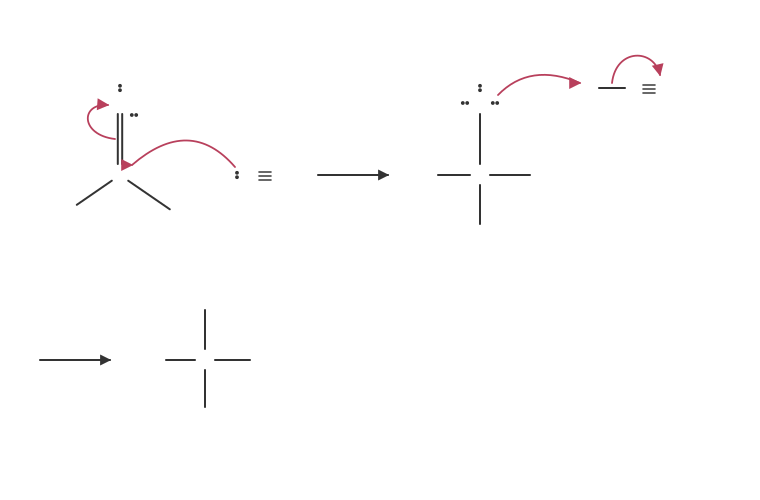
Step 1: the cyanide ion, :CN−, uses the lone pair on its carbon atom to attack the δ+ carbonyl carbon. At the same time the π bond of C=O breaks and its pair of electrons moves onto the oxygen. This forms a negatively charged intermediate with an O− group.
Step 2: the O− uses a lone pair to accept a proton, H+, from an HCN molecule (or from H+ in solution), forming the OH group. Taking H+ from HCN regenerates a CN− ion.
Sign in free to see the rest of this lesson, the R.E.C.I.P.E. recall steps and the quiz
BrainCake is free. Make an account in seconds and pick up where this page stops.
More in Carbonyl Compounds
- Physical Properties of Carbonyls
- Oxidation of Aldehydes
- Tollens' Reagent
- Fehling's and Benedict's Solutions
- Iodoform Reaction
- 2,4-DNPH Test
- Reduction with LiAlH4
- Reaction with HCN
All 11 lessons in Carbonyl Compounds · All Edexcel A-level Chemistry topics