 BRAINCAKE
Worked Example
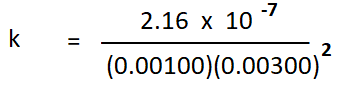
Experiments are carried out to investigate the kinetics (rate of reaction) of three compounds A, B and C that react together. The results are shown in the table. Comparing experiment 1 to experiment 2, [A] and [C] are constant. However, [B] doubles (×2) and the rate quadruples (×22), so the rate is second order with respect to B. Comparing experiments 2 with 3, [B] and [C] are constant but [A] has decreased by ×0.5 whilst the rate has decreased by ×0.5 . Therefore, the reaction is 1st order with respect to A.
Sign in free to see the rest of this lesson, the R.E.C.I.P.E. recall steps and the quiz
BrainCake is free. Make an account in seconds and pick up where this page stops.
More in Rate of Reaction
- Experimental Determination of the Rate of Reaction
- The Rate Equation
- The Order of a Reaction
- The Rate Constant k
- Half-Lives and Reaction Rate Graphs
- The Rate Determining Step
- Catalysts
- The Effect of Temperature and Catalysts on the Rate Constant.
All 11 lessons in Rate of Reaction · All AQA A-level Chemistry topics