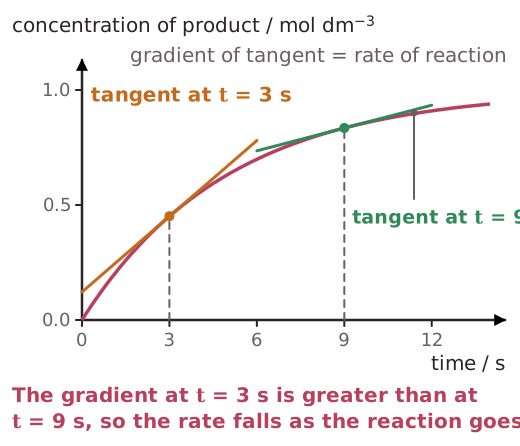
Particles only react if they have sufficient energy. The minimum energy required is the activation energy. The greater the number of successful collisions per second, the faster the rate of reaction. The concentration of the reactants decreases with time so the rate of a reaction will decrease with time, so we take only the initial rate of the reaction into consideration. We work out the rate of reaction at several different initial concentrationsand plot a graph of rate against concentration and see the effect of the initial concentration of reactants on the rate of reaction. The equation for this relationship is called the rate equation.e.g.2 H2(g) + 2 NO (g) → 2 H2O(g) + N2(g) has the following rate equation: rate = k [H2(g)] [ NO(g)] 2[] = concentrations. k = constant of proportionality, the rate constant. When the concentration of H2 doubles, the rate doubles, when the concentration of NO doubles the rate quadruples. This is obtained experimentally and cannot be deduced from the stoichiometry.