The half-life of a reactant is the time taken for the concentration of a reactant to reduce by half. If the order is zero with respect to a reactant, the concentration of the reactant does not affect the rate of reaction. A zero-order reaction has a decreasing half-life. If the order is one with respect to a reactant, the rate of reaction doubles if the concentration of the reactant doubles. The rate is directly proportional to the concentration. A first-order reaction has a constant half-life. If the order is two with respect to a reactant, the rate is proportional to the square of the concentration of the reactant. A second-order reaction has an increasing half-life.
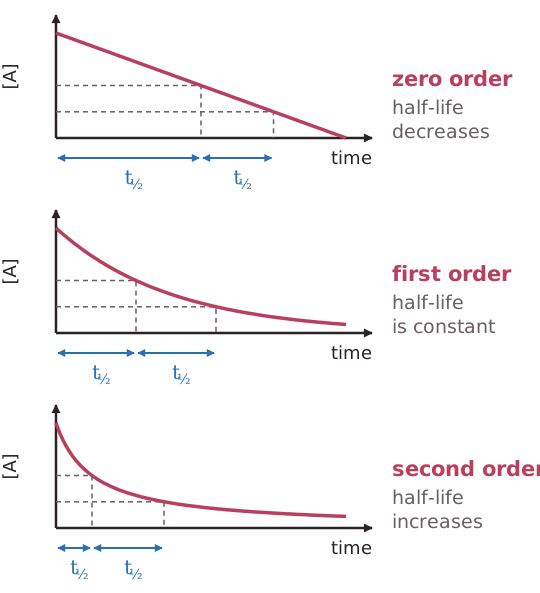
Half-Lives and Reaction Rate Graphs
Read the text
Read the text and highlight anything you think is important. When you go on, the text is hidden and you answer from memory.
Specification: AQA Chemistry (7405), A-level, 3.1.9.2 Determination of rate equation. Topic: Rate of Reaction.
Key terms in this lesson
- acid dissociation constant
- The equilibrium constant, given the symbol Ka, for the dissociation of a weak acid into its ions in aqueous solution.
More in Rate of Reaction
- Experimental Determination of the Rate of Reaction
- The Rate Equation
- The Order of a Reaction
- The Rate Constant k
- Worked Example
- The Rate Determining Step
- Catalysts
- The Effect of Temperature and Catalysts on the Rate Constant.
All 11 lessons in Rate of Reaction · All AQA A-level Chemistry topics