A racemic mixture (or racemate) is a mixture containing equal amounts (equimolar amounts) of the two enantiomers of a chiral compound.Each enantiomer rotates plane-polarised light by the same angle but in the opposite direction. In a racemic mixture the two rotations cancel each other out, so the mixture has no effect on plane-polarised light. A racemic mixture is therefore optically inactive.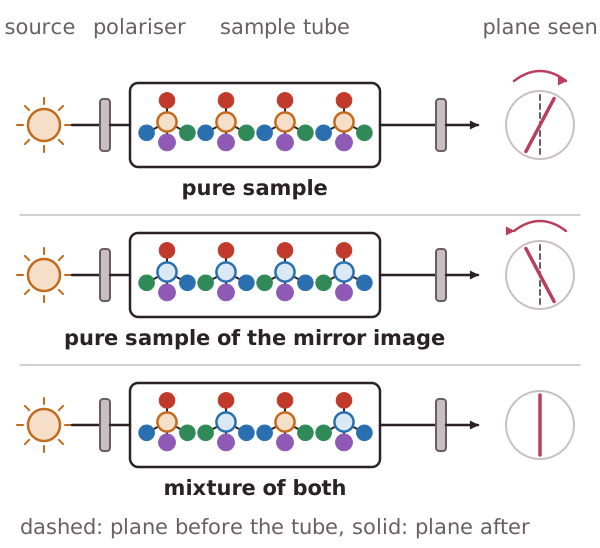 Be careful to distinguish two kinds of optically inactive sample:
• an achiral compound is inactive because its molecules have no chiral centre;
• a racemic mixture is inactive even though every molecule is chiral, because the two enantiomers are present in equal amounts.Racemic mixtures are formed when a chiral product is made from achiral reactants, because both enantiomers are produced equally (the next lesson shows how this happens).Why it matters: many drugs are chiral, and often only one enantiomer has the desired effect. The other may be inactive or cause side effects. A racemic product may have to be separated, or the synthesis designed to make a single enantiomer, which makes the drug more expensive to produce.Worked example: a pure enantiomer rotates plane-polarised light by +12°. A mixture contains 75% of it and 25% of the other enantiomer. The 25% of the other enantiomer cancels 25% of the first, leaving an excess of 50% of the first enantiomer. The rotation is 0.50 × (+12°) = +6°.
Be careful to distinguish two kinds of optically inactive sample:• an achiral compound is inactive because its molecules have no chiral centre;
• a racemic mixture is inactive even though every molecule is chiral, because the two enantiomers are present in equal amounts.Racemic mixtures are formed when a chiral product is made from achiral reactants, because both enantiomers are produced equally (the next lesson shows how this happens).Why it matters: many drugs are chiral, and often only one enantiomer has the desired effect. The other may be inactive or cause side effects. A racemic product may have to be separated, or the synthesis designed to make a single enantiomer, which makes the drug more expensive to produce.Worked example: a pure enantiomer rotates plane-polarised light by +12°. A mixture contains 75% of it and 25% of the other enantiomer. The 25% of the other enantiomer cancels 25% of the first, leaving an excess of 50% of the first enantiomer. The rotation is 0.50 × (+12°) = +6°.