Skip to content

Racemates from Nucleophilic Addition

The carbonyl group, C=O, is planar. The carbonyl carbon and the three atoms bonded to it lie in one plane, in a trigonal planar arrangement with bond angles of about 120°.In nucleophilic addition, a nucleophile such as CN− attacks the δ+ carbonyl carbon. Because the group is flat, the nucleophile can attack from either side of the plane (from above or below), and each side is equally likely.
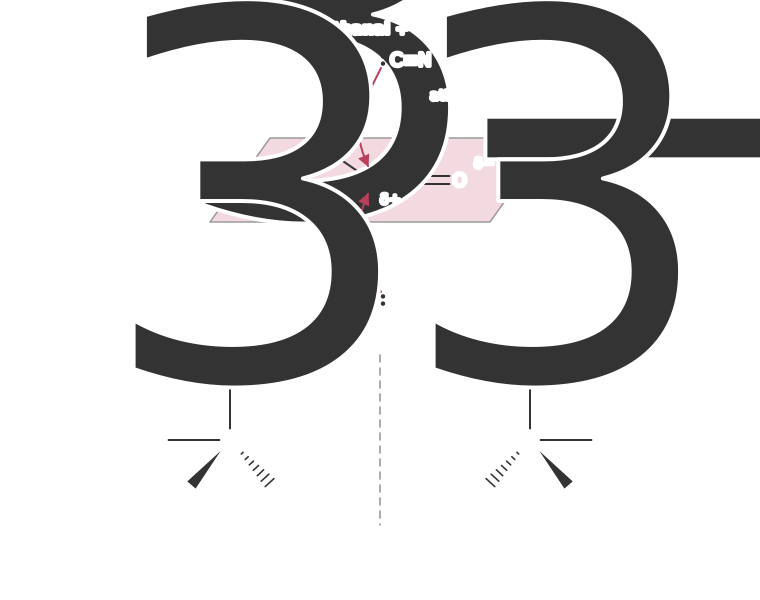
If the two groups already on the carbonyl carbon are different (any aldehyde except methanal, or an unsymmetrical ketone), the product carbon now has four different groups, so it is a chiral centre. Attack from one side gives one enantiomer and attack from the other side gives the other enantiomer. Since both are equally likely, the product is a racemic mixture, which is optically inactive.Example: ethanal, CH3CHO, reacts with KCN followed by dilute acid to give 2-hydroxypropanenitrile, CH3CH(OH)CN. Carbon 2 carries H, OH, CH3 and CN, and the product is a racemic mixture of its two enantiomers.If the carbonyl carbon carries two identical groups, no chiral centre forms. Propanone gives 2-hydroxy-2-methylpropanenitrile, whose central carbon has two CH3 groups, so it is not chiral.The same idea applies to reduction with NaBH4, where the nucleophile is H−: butanone is reduced to a racemic mixture of butan-2-ol.

Read the text

Read the text and highlight anything you think is important. When you go on, the text is hidden and you answer from memory.

Specification: AQA Chemistry (7405), A-level, 3.3.7 Optical isomerism. Topic: Optical Isomerism.

Key terms in this lesson

macromolecular
Describes a giant covalent structure in which atoms are joined throughout by strong covalent bonds, such as in silicon dioxide.
polarisation
The distortion of the electron cloud of a negative ion caused by the attraction of a nearby positive ion, giving the bond some covalent character.

More in Optical Isomerism

All 6 lessons in Optical Isomerism · All AQA A-level Chemistry topics