Ordinary light is made of waves that vibrate in all planes at right angles to the direction the light travels. If it passes through a polariser (a polarising filter), only the vibrations in one plane get through. This is plane-polarised light.A substance that rotates the plane of plane-polarised light is optically active. Chiral compounds are optically active; achiral compounds are not, so light passes through their solutions with its plane unchanged.
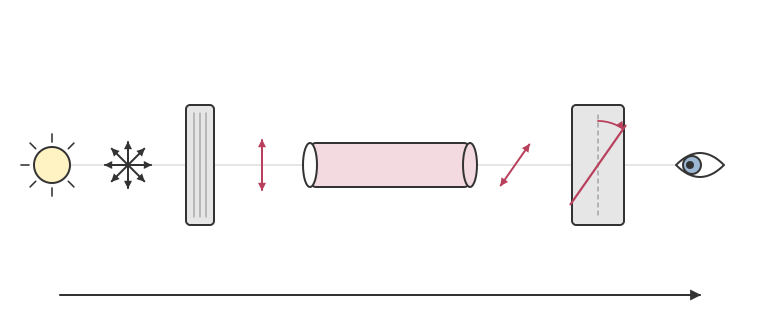
The rotation is measured in a polarimeter. Light passes through a polariser, then through a tube containing a solution of the sample, then through a second filter (the analyser). The analyser is turned until the maximum amount of light passes through, and the angle it has been turned through is the angle of rotation.The two enantiomers of a compound rotate plane-polarised light by the same angle in opposite directions (under the same conditions of concentration, path length, temperature and wavelength). One rotates the plane clockwise, the other anticlockwise. This is the only simple physical way to tell enantiomers apart, because their other physical properties are identical.Worked example: a solution of one enantiomer rotates plane-polarised light by +12° (clockwise). Under the same conditions, a solution of the other enantiomer at the same concentration rotates it by −12° (anticlockwise). A solution of an achiral compound would rotate it by 0°.
Plane-Polarised Light
Read the text
Read the text and highlight anything you think is important. When you go on, the text is hidden and you answer from memory.
Specification: AQA Chemistry (7405), A-level, 3.3.7 Optical isomerism. Topic: Optical Isomerism.
More in Optical Isomerism
- Chirality
- Optical Isomers
- Racemic Mixtures
- Racemates from Nucleophilic Addition
- Identifying Chiral Centres
All 6 lessons in Optical Isomerism · All AQA A-level Chemistry topics