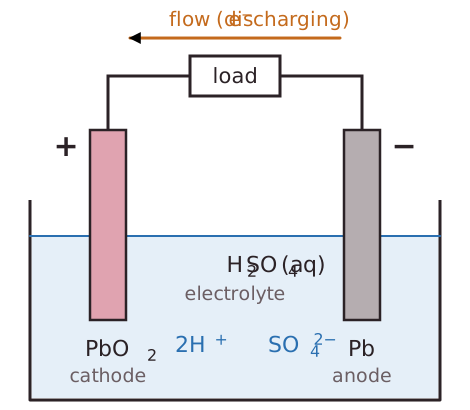
The reactions in rechargeable cells can be reversed using electrical energy so the cell can be re-used. Examples are Ni-Cd (nickel-cadmium) batteries, lithium-ion batteries and lithium polymer batteries used in laptops. Lead-acid batteries are used in cars. Each cell has two lead plates. The cathode is coated with lead (IV) oxide. The electrolyte is concentrated sulfuric acid. At the anode:Pb(s) + SO42-(aq) → PbSO4(s) + 2e-At the cathode:PbO2(s) +4H+(aq) + SO42-(aq) + 2e- → PbSO4(s) + 2H2O(l)Overall:Pb(s) + PbO2(s) + 4H+(aq) + 2SO42-(aq) → 2PbSO4(s) + 2H2O(l)With rechargeable batteries the oxidised and reduced forms of the anode and cathode must be solid. Digital cameras and mobile phones use rechargeable Lithium cells that use a solid polymer electrolyte. One type of battery has a lithium anode and a titanium (IV) sulfide cathode. At the anode:Li ⇌ Li+ + e-At the cathode:TiS2 + e- ⇌ TiS2-OverallLi(s) + TiS2(s) → LiTiS2(s)