Nylon-6,6 and Kevlar are both polyamides, but their monomers give them very different properties.Nylon-6,6 is made from hexane-1,6-diamine and hexanedioic acid (or hexanedioyl dichloride). The name comes from the six carbon atoms in each monomer.n H2N(CH2)6NH2 + n HOOC(CH2)4COOH → [-NH(CH2)6NH-CO(CH2)4CO-]n + (2n − 1) H2O Kevlar is made from benzene-1,4-diamine and benzene-1,4-dicarboxylic acid (or benzene-1,4-dicarbonyl dichloride). Its repeating unit is [-NH-C6H4-NH-CO-C6H4-CO-]n.
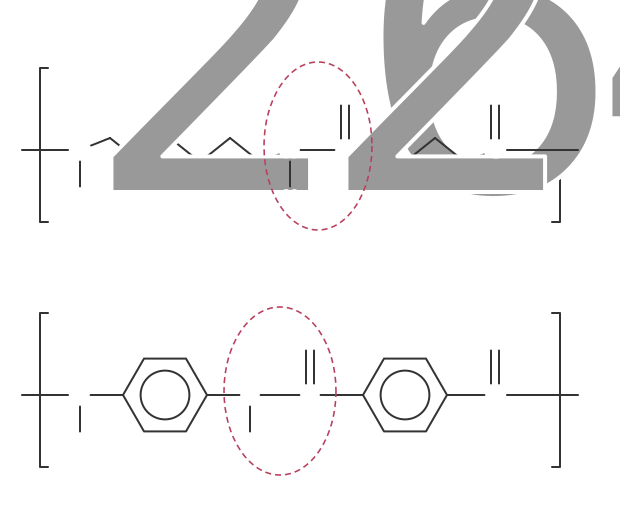
The benzene rings make Kevlar chains flat and rigid. The chains line up side by side and form many hydrogen bonds between the C=O and N-H groups of neighbouring chains, giving a material that is very strong for its mass. Nylon-6,6 has flexible (CH2) sections, so it is strong but also stretchy.Uses: nylon-6,6 is used for clothing, carpets, ropes and fishing line; Kevlar is used in bulletproof vests (body armour), protective helmets and to reinforce tyres.Worked example. Find Mr of the nylon-6,6 repeating unit, C12H22N2O2: (12 × 12.0) + (22 × 1.0) + (2 × 14.0) + (2 × 16.0) = 144 + 22 + 28 + 32 = 226.
Nylon-6,6 and Kevlar
Read the text
Read the text and highlight anything you think is important. When you go on, the text is hidden and you answer from memory.
Specification: AQA Chemistry (7405), A-level, 3.3.12.1 Condensation polymers. Topic: Condensation Polymers.
More in Condensation Polymers
- Condensation Polymers
- Polyesters
- Polyamides
- Drawing Repeat Units
- Hydrogen Bonding between Polymer Chains
- Biodegradability of Polymers
- Disposal and Recycling of Polymers
All 8 lessons in Condensation Polymers · All AQA A-level Chemistry topics