A weak acid has the following equilibrium in aqueous solution:HA (aq) ⇌ H+(aq) + A-(aq)The expression for the acid dissociation constant is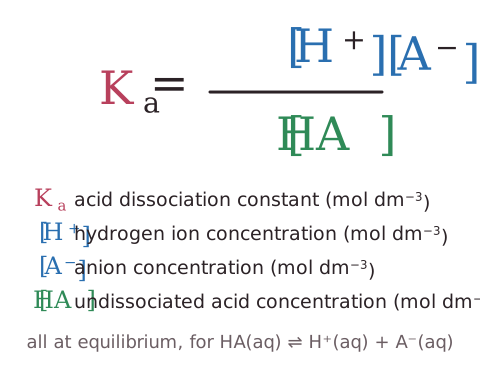 The units can be found by substituting units for the concentrations
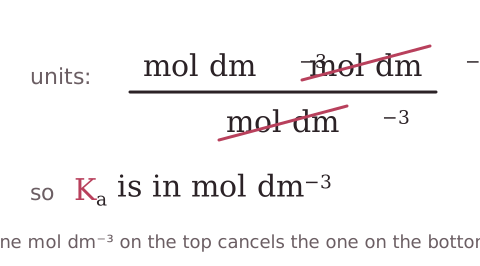
Ka = [H+(aq)][A-(aq)] / [HA(aq)] Substituting mol dm-3 for each concentration gives (mol dm-3 × mol dm-3) / mol dm-3, so Ka has units of mol dm-3.The value of Ka measures the extent of dissociation. A weak acid dissociates only partially, so at equilibrium most of it is still present as HA and there are few dissociated ions: Ka is small. The larger the Ka, the greater the extent of dissociation and the stronger the acid. Ethanoic acid has Ka = 1.7 × 10⁻⁵ mol dm-3, and methanoic acid, with a larger Ka, is the stronger of the two.Strong acids such as HCl, HNO3 and HBr dissociate completely in water, so they are not given Ka values.Because Ka values are often very small, they are also quoted as pKa = −log10Ka. A smaller pKa means a stronger acid. Like every equilibrium constant, Ka changes only with temperature.
The units can be found by substituting units for the concentrations