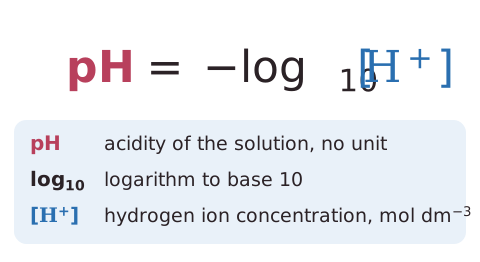
Strong acids completely dissociate in aqueous solution.HCl(aq) → H+(aq) + Cl-(aq)This means that the acid concentration and the hydrogen ion concentration are the same. [H+] = [HCl] so the pH of 0.2moldm-3 of HCl is -log100.2 which is 0.699 to 3 s.f.Sulfuric acid is a dibasic acid.H2SO4(aq) → 2 H+(aq) + SO42-(aq)This means that the hydrogen ion concentration is twice the concentration of the acid. [H+] = 2[H2SO4] because two hydrogen ions are released for each molecule of acid. So the pH of 0.2moldm-3 of H2SO4 is -log10(0.2x2)which is 0.398 to 3 s.f.
Calculating the pH of a Strong Acid
Read the text
Read the text and highlight anything you think is important. When you go on, the text is hidden and you answer from memory.
Specification: AQA Chemistry (7405), A-level, 3.1.12.2 Definition and determination of pH. Topic: Acids, Bases and Buffers.
Key terms in this lesson
- standard hydrogen half cell
- A half cell of hydrogen gas over a platinum electrode in 1 mol dm-3 H+ ions at 298 K, given an electrode potential of 0.00 V by definition.
More in Acids, Bases and Buffers
- Conjugate Acid-Base Pairs
- Strong and Weak Acids and Bases
- The Acid Dissociation Constant Ka
- pH
- Calculating the pH of a Weak Acid
- The Ionic Product of Water Kw
- Calculating the pH of a Strong Base
- Buffer Solutions
All 15 lessons in Acids, Bases and Buffers · All AQA A-level Chemistry topics