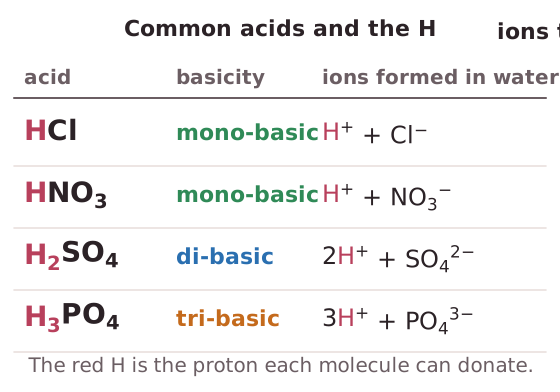
When an acid is added to water it dissociates into H+ ions and anions. For example:HCl(g) + aq → H+(aq) + Cl-(aq)The proton or hydrogen ion released is donated to a water molecule which acts as a base.H+(aq) + H2O(l) → H3O+(aq)The hydroxonium (or oxonium) H3O+(aq)ion is formed. Different acids release different number of protons and are mono-, di- and tri- basic. Examples are HCl (mono-basic), H2SO4 (di-basic) and H3PO4 (tri-basic). In acid-base reactions (neutralisation), acids neutralise bases, alkalis and carbonates. In all these reactions, the reaction stops when all the H+ ions have been released. The reaction of an acid with a metal is a redox reaction and not a neutralisation reaction.