The gill lamellae have a rich blood supply.The flow of water over the gill lamellae and the flow of blood through the gill lamellae are in opposite directions.This ensures the maximum possible gas exchange.Blood that is already loaded with oxygen meets water with a maximum concentration of oxygen so diffusion still takes place.Blood with little oxygen meets water with most but not all of its oxygen removed.Again diffusion still takes place.The countercurrent flow ensures that diffusion takes place over the entire length of the gill lamella. This is necessary as the concentration of oxygen in water is relatively low.In contrast, concurrent flow would achieve an equilibrium before the end of the gill lamellae and diffusion would stop.
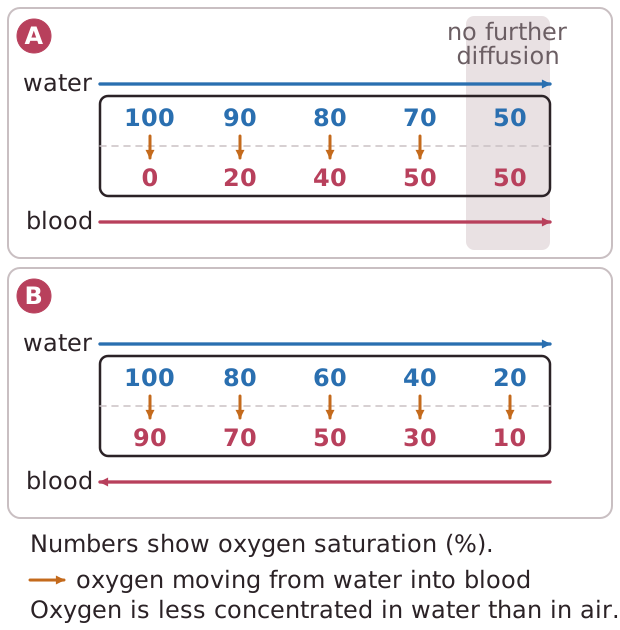
Counter Current Exchange
Read the text
Read the text and highlight anything you think is important. When you go on, the text is hidden and you answer from memory.
Specification: OCR Biology A (H020), AS-level, 3.1.1 Exchange surfaces. Topic: Exchange Surfaces and Breathing.
Key terms in this lesson
- diffusion
- The net movement of molecules or ions from a region of higher concentration to a region of lower concentration, down a concentration gradient.
More in Exchange Surfaces and Breathing
- Gas Exchange in Unicellular Organisms
- Gas Exchange in Insects
- Diffusion Gradient
- Mass Transport
- Increasing the Rate of Diffusion
- Limitations of the Tracheal System
- Gas Exchange in Fish
- Structure of the Gills
All 24 lessons in Exchange Surfaces and Breathing · All OCR AS-level Biology topics