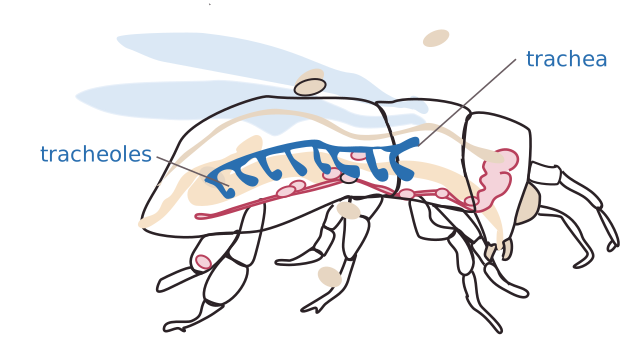
The need for gas exchange conflicts with the need to conserve water.Pores in the exoskeleton called spiracles lead to a network of internal tubes called tracheae that branch into tracheoles that extend through the body tissues of the insect.The trachea are supported by rings of chitin to prevent them collapsing.There is a short diffusion pathway from the tracheoles to the cells. Oxygen diffuses from the air in the tracheoles down its concentration gradient. Carbon dioxide diffuses from respiring tissue into the tracheoles. Diffusion takes place more rapidly in air.The insects can squeeze the trachea by muscle contraction enabling mass flow of air in and out.The ends of the tracheoles are filled with water so the final diffusion pathway is in water. This reduces the amount of evaporation from the tracheoles.