All viruses share the same basic plan: a core of nucleic acid protected by a protein coat. Some also have an outer envelope.Nucleic acid. The genome may be DNA or RNA, and it may be single-stranded or double-stranded. It carries the genes needed to make new virus particles, and is usually very small, with only a few genes to a few hundred genes.Capsid. The protein coat is the capsid. It is built from many identical protein subunits called capsomeres, which fit together in a regular pattern. The capsid protects the nucleic acid and, in many viruses, carries the attachment proteins that bind to receptors on the host cell. The nucleic acid plus capsid is called the nucleocapsid.Envelope. Many animal viruses, such as influenza and HIV, have a lipid envelope outside the capsid. The envelope is taken from the host cell's membrane as the virus leaves, and viral glycoproteins stick out of it as spikes used for attachment. Viruses without an envelope are called naked viruses.Some viruses also carry enzymes inside the particle, for example reverse transcriptase in HIV.Capsids have three main shapes:
• helical: a rod of capsomeres coiled around the nucleic acid, e.g. tobacco mosaic virus
• polyhedral (icosahedral, 20 faces), e.g. adenovirus
• complex, e.g. the T4 bacteriophage, which has a polyhedral head, a tail sheath and tail fibres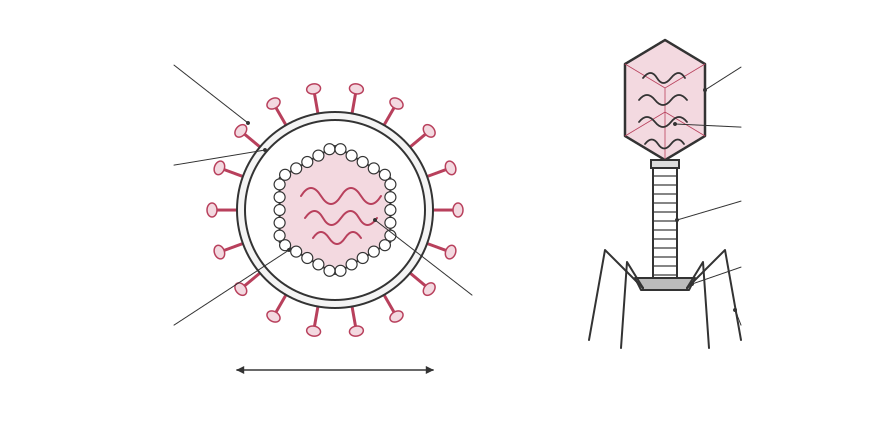
• helical: a rod of capsomeres coiled around the nucleic acid, e.g. tobacco mosaic virus
• polyhedral (icosahedral, 20 faces), e.g. adenovirus
• complex, e.g. the T4 bacteriophage, which has a polyhedral head, a tail sheath and tail fibres