As well as the Gram stain, bacteria can be classified by their shape and by their respiratory requirements.Shape. The main shapes seen under the microscope are:
• cocci (singular coccus): spherical, e.g. Staphylococcus
• bacilli (singular bacillus): rod-shaped, e.g. E. coli, Salmonella
• spirilla (singular spirillum): spiral or corkscrew-shaped, e.g. Treponema (spirochaetes)
• vibrios: comma-shaped, e.g. Vibrio choleraeThe way cells stay together after dividing is also useful. Staphylo- means grape-like clusters (Staphylococcus), strepto- means chains (Streptococcus) and diplo- means pairs (Diplococcus).Respiratory requirements. Bacteria differ in their need for oxygen:
• Obligate aerobes need oxygen for respiration and cannot grow without it, e.g. Mycobacterium tuberculosis.
• Facultative anaerobes respire aerobically when oxygen is present but can switch to anaerobic respiration when it is absent, e.g. E. coli, Staphylococcus.
• Obligate anaerobes can only respire anaerobically; oxygen is toxic to them, e.g. Clostridium.A simple way to show respiratory type is to grow bacteria in a tube of nutrient broth or agar. Obligate aerobes grow only at the top where oxygen is present, obligate anaerobes grow only at the bottom, and facultative anaerobes grow throughout, most densely near the top.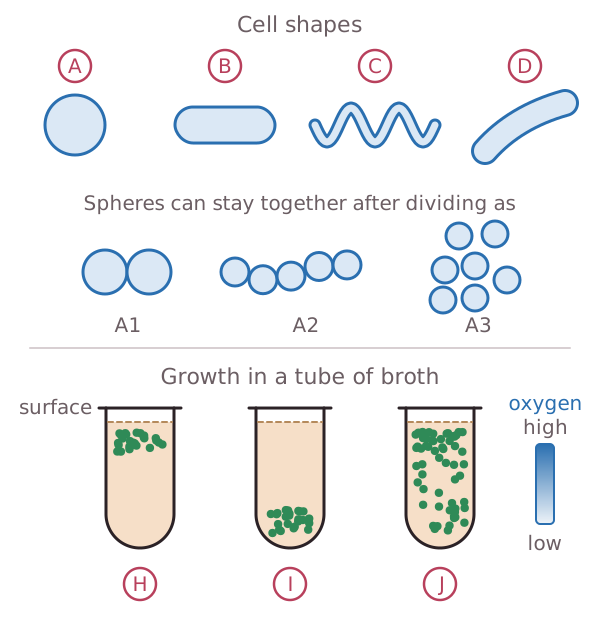 Combining shape, Gram reaction and oxygen requirement narrows down the identity of an unknown bacterium.
• cocci (singular coccus): spherical, e.g. Staphylococcus
• bacilli (singular bacillus): rod-shaped, e.g. E. coli, Salmonella
• spirilla (singular spirillum): spiral or corkscrew-shaped, e.g. Treponema (spirochaetes)
• vibrios: comma-shaped, e.g. Vibrio choleraeThe way cells stay together after dividing is also useful. Staphylo- means grape-like clusters (Staphylococcus), strepto- means chains (Streptococcus) and diplo- means pairs (Diplococcus).Respiratory requirements. Bacteria differ in their need for oxygen:
• Obligate aerobes need oxygen for respiration and cannot grow without it, e.g. Mycobacterium tuberculosis.
• Facultative anaerobes respire aerobically when oxygen is present but can switch to anaerobic respiration when it is absent, e.g. E. coli, Staphylococcus.
• Obligate anaerobes can only respire anaerobically; oxygen is toxic to them, e.g. Clostridium.A simple way to show respiratory type is to grow bacteria in a tube of nutrient broth or agar. Obligate aerobes grow only at the top where oxygen is present, obligate anaerobes grow only at the bottom, and facultative anaerobes grow throughout, most densely near the top.
Combining shape, Gram reaction and oxygen requirement narrows down the identity of an unknown bacterium.