Many bacteria have thin projections from their surface: pili and flagella. They are made of protein and extend through the cell wall and capsule.Pili (singular: pilus)
Pili are short, thin, hair-like protein projections, often covering the whole cell surface. Their functions are:
• Attachment: pili let bacteria stick to surfaces, including host cells, for example the cells lining the urinary tract or gut. This helps pathogenic bacteria to colonise the host and not be washed away.
• Conjugation: a longer sex pilus links two bacteria, and a copy of a plasmid can pass from one cell to the other. This allows genes, such as those for antibiotic resistance, to spread between bacteria, even between different species.Flagella (singular: flagellum)
A bacterial flagellum is a long, whip-like, rigid spiral filament made of the protein flagellin. A cell may have one or several.
• The filament is attached at its base to a rotary motor embedded in the cell wall and cell surface membrane.
• The motor is driven by the flow of hydrogen ions (protons) across the membrane, and makes the flagellum rotate like a propeller, pushing the bacterium through liquid.
• This lets bacteria move towards nutrients and away from harmful substances.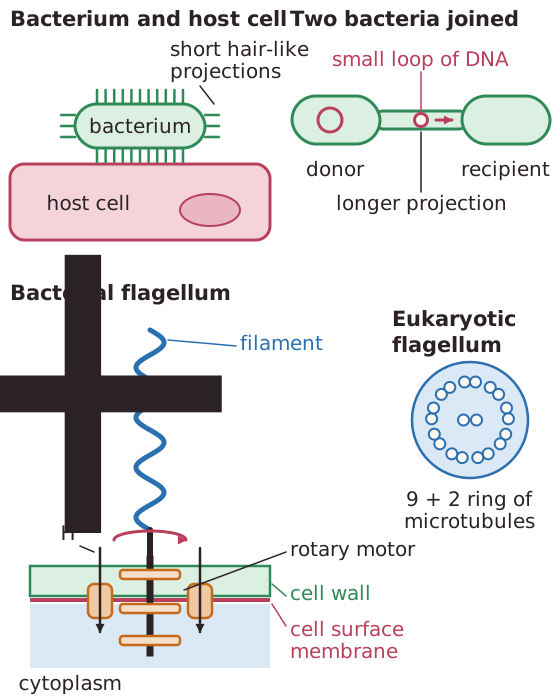 Not the same as eukaryotic flagella
Bacterial flagella are much thinner (about 20 nm), are not surrounded by the cell membrane, contain no microtubules and rotate rather than beat. Eukaryotic flagella, such as a sperm tail, contain microtubules in a 9 + 2 arrangement and move with a bending, whip-like action.
Pili are short, thin, hair-like protein projections, often covering the whole cell surface. Their functions are:
• Attachment: pili let bacteria stick to surfaces, including host cells, for example the cells lining the urinary tract or gut. This helps pathogenic bacteria to colonise the host and not be washed away.
• Conjugation: a longer sex pilus links two bacteria, and a copy of a plasmid can pass from one cell to the other. This allows genes, such as those for antibiotic resistance, to spread between bacteria, even between different species.Flagella (singular: flagellum)
A bacterial flagellum is a long, whip-like, rigid spiral filament made of the protein flagellin. A cell may have one or several.
• The filament is attached at its base to a rotary motor embedded in the cell wall and cell surface membrane.
• The motor is driven by the flow of hydrogen ions (protons) across the membrane, and makes the flagellum rotate like a propeller, pushing the bacterium through liquid.
• This lets bacteria move towards nutrients and away from harmful substances.
Not the same as eukaryotic flagellaBacterial flagella are much thinner (about 20 nm), are not surrounded by the cell membrane, contain no microtubules and rotate rather than beat. Eukaryotic flagella, such as a sperm tail, contain microtubules in a 9 + 2 arrangement and move with a bending, whip-like action.