Desert pupfish are small fish of the genus Cyprinodon that live in isolated springs, streams and pools in the deserts of south-western USA and northern Mexico. They are a well-known example of allopatric speciation.During the last ice age, the Death Valley region of California and Nevada was much wetter. Large lakes and rivers connected the area, and a single ancestral pupfish population lived throughout it.As the climate warmed and became drier over roughly the last 10,000 years, the lakes shrank and dried up. The pupfish population was split into many small groups, each trapped in a separate spring or pool surrounded by desert. The desert was a geographical barrier, so there was no gene flow between the groups.Each pool had different conditions, for example temperature, salinity and oxygen level. So each isolated population faced different selection pressures, and in such small populations genetic drift also changed allele frequencies. Over time, the groups diverged into several different species and subspecies, each endemic to its own spring or stream.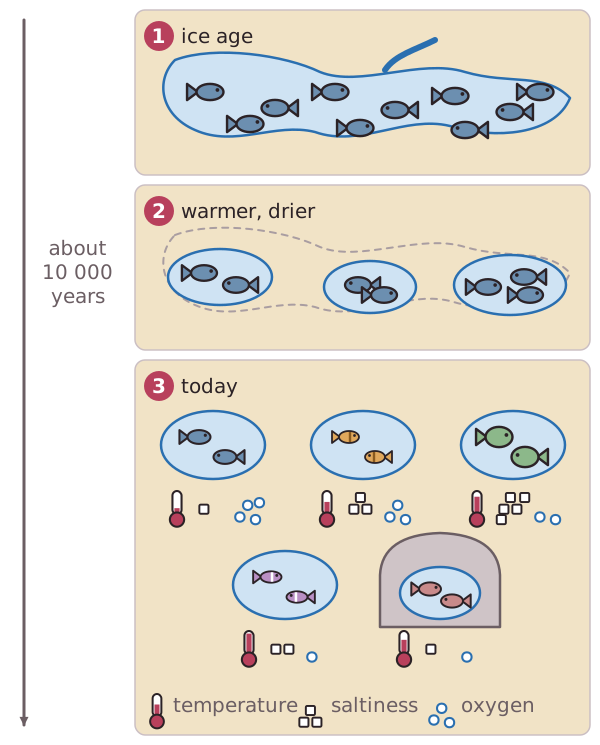 Examples include:1. The Devils Hole pupfish (Cyprinodon diabolis), which lives in a single water-filled limestone cavern in Nevada, in water at about 33 °C with low oxygen. It is one of the rarest fish in the world, and its whole wild population can number only a few hundred or fewer.2. The Salt Creek pupfish (Cyprinodon salinus), adapted to very salty water.Because each species lives in one small habitat, pupfish are highly vulnerable to extinction, for example from groundwater pumping.