Adaptive radiation is the rapid evolution of many new species from a single common ancestor, with each new species adapted to a different niche.It usually happens when an ancestral species reaches an environment with many unoccupied niches and few competitors. This can happen when:1. Organisms colonise a new, isolated area, such as a group of islands.2. A mass extinction removes competitors, as when mammals diversified after the extinction of the dinosaurs.3. A new adaptation opens up a new way of life.The process combines the ideas of isolation and natural selection. Populations of the ancestor spread into different habitats or islands and become isolated. Each population faces different selection pressures, for example different food sources, so natural selection favours different adaptations. Over many generations each group becomes a new species, specialised for its own niche.Darwin's finches on the Galapagos Islands are the classic example. A single ancestral finch species colonised the islands from South America. Its descendants evolved into many species (currently about 15 are recognised) with different beak shapes suited to different foods: large, deep beaks for cracking hard seeds, thin pointed beaks for catching insects, and, in the woodpecker finch, a beak used to hold a cactus spine to extract insect larvae.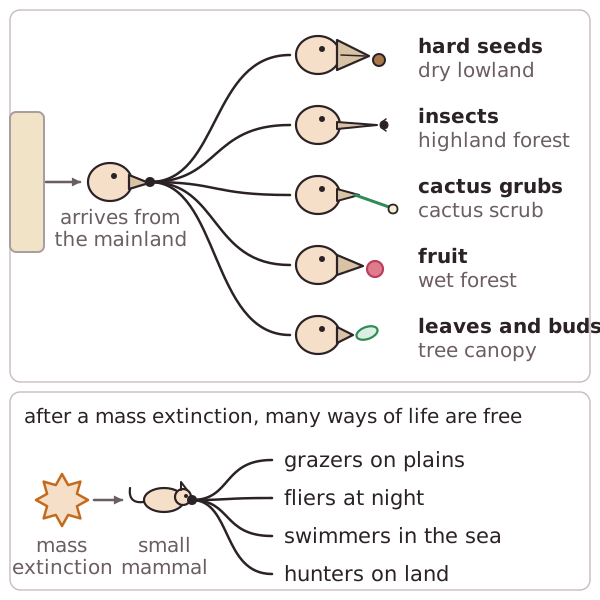 Other examples include the Hawaiian honeycreepers, which evolved from one finch-like ancestor into many species with very different beaks, and the cichlid fish of the African Great Lakes.Adaptive radiation greatly increases biodiversity and produces many endemic species.