Telophase I is the final stage of the first meiotic division. It begins when the homologous chromosomes have reached opposite poles at the end of anaphase I.In most animal cells:
• a nuclear envelope reforms around each group of chromosomes, giving two nuclei;
• the nucleolus reappears;
• the chromosomes may uncoil slightly;
• the spindle breaks down.
Cytokinesis then divides the cytoplasm, producing two cells.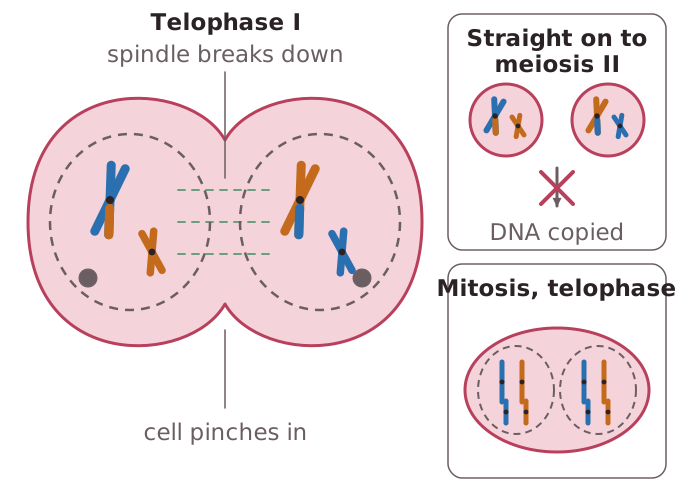 Each of the two new nuclei is haploid: it contains one chromosome from each homologous pair. However, each chromosome still consists of two chromatids, and because of crossing over in prophase I these two chromatids are usually no longer identical.The two cells produced are genetically different from each other and from the parent cell, because of independent assortment and crossing over.In some species telophase I is very brief, and the cell passes almost directly into meiosis II with the chromosomes still condensed.A short resting stage, sometimes called interkinesis, may follow telophase I. The important point is that there is no DNA replication between meiosis I and meiosis II. If the DNA were copied again, the gametes would end up with twice the correct amount of DNA.Worked example: a cell with 2n = 12 enters meiosis. At the end of telophase I, each of the two cells contains 6 chromosomes, which is 12 chromatids.
• a nuclear envelope reforms around each group of chromosomes, giving two nuclei;
• the nucleolus reappears;
• the chromosomes may uncoil slightly;
• the spindle breaks down.
Cytokinesis then divides the cytoplasm, producing two cells.
Each of the two new nuclei is haploid: it contains one chromosome from each homologous pair. However, each chromosome still consists of two chromatids, and because of crossing over in prophase I these two chromatids are usually no longer identical.The two cells produced are genetically different from each other and from the parent cell, because of independent assortment and crossing over.In some species telophase I is very brief, and the cell passes almost directly into meiosis II with the chromosomes still condensed.A short resting stage, sometimes called interkinesis, may follow telophase I. The important point is that there is no DNA replication between meiosis I and meiosis II. If the DNA were copied again, the gametes would end up with twice the correct amount of DNA.Worked example: a cell with 2n = 12 enters meiosis. At the end of telophase I, each of the two cells contains 6 chromosomes, which is 12 chromatids.