Meiosis II is the second division of meiosis. It takes place in both haploid cells produced by meiosis I, and it separates the sister chromatids of each chromosome. It follows the same stages as mitosis:
• Prophase II: the chromosomes condense again (if they had uncoiled), the nuclear envelope breaks down and a new spindle forms, often at right angles to the first.
• Metaphase II: the chromosomes line up singly on the equator, with spindle fibres from opposite poles attached to each centromere. Because the chromatids are no longer identical after crossing over, the way they face the poles is random, which adds further variation.
• Anaphase II: the centromeres divide, and the chromatids are pulled to opposite poles.
• Telophase II: nuclear envelopes reform around the four groups of chromosomes, and cytokinesis follows.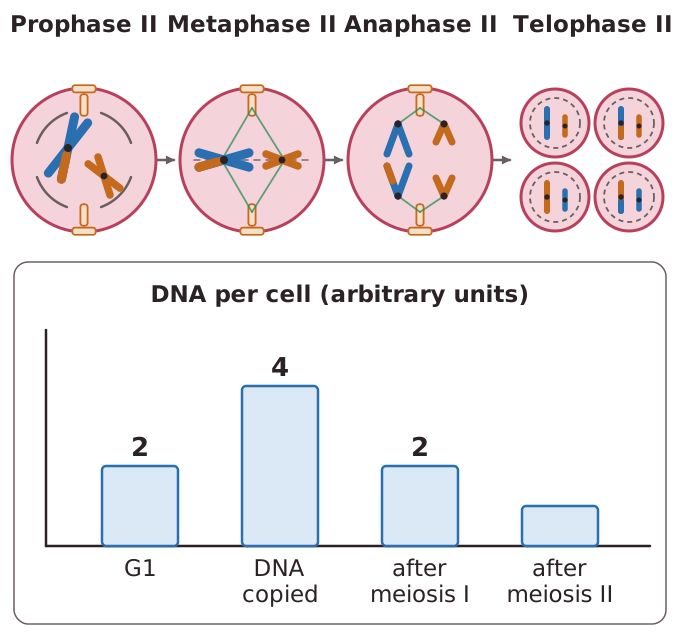 The result is four haploid cells, in which each chromosome is a single chromatid. The four cells are genetically different from each other.Although meiosis II looks like mitosis, it differs in three ways: the cells are haploid, there is no DNA replication beforehand, and the chromatids being separated are not genetically identical.Worked example: in humans, a cell entering meiosis II has 23 chromosomes (46 chromatids). After meiosis II each of the four cells has 23 chromosomes, each a single chromatid.Tracking DNA content (arbitrary units): a diploid cell has 2 units in G1 and 4 after replication, then 2 in each cell after meiosis I and 1 in each cell after meiosis II.
• Prophase II: the chromosomes condense again (if they had uncoiled), the nuclear envelope breaks down and a new spindle forms, often at right angles to the first.
• Metaphase II: the chromosomes line up singly on the equator, with spindle fibres from opposite poles attached to each centromere. Because the chromatids are no longer identical after crossing over, the way they face the poles is random, which adds further variation.
• Anaphase II: the centromeres divide, and the chromatids are pulled to opposite poles.
• Telophase II: nuclear envelopes reform around the four groups of chromosomes, and cytokinesis follows.
The result is four haploid cells, in which each chromosome is a single chromatid. The four cells are genetically different from each other.Although meiosis II looks like mitosis, it differs in three ways: the cells are haploid, there is no DNA replication beforehand, and the chromatids being separated are not genetically identical.Worked example: in humans, a cell entering meiosis II has 23 chromosomes (46 chromatids). After meiosis II each of the four cells has 23 chromosomes, each a single chromatid.Tracking DNA content (arbitrary units): a diploid cell has 2 units in G1 and 4 after replication, then 2 in each cell after meiosis I and 1 in each cell after meiosis II.