In metaphase I the bivalents (pairs of homologous chromosomes) line up across the equator of the spindle. Spindle fibres from opposite poles attach to the centromeres: the centromere of one homologous chromosome is attached to fibres from one pole, and the centromere of its partner to fibres from the other pole.This is the key difference from metaphase of mitosis, in which individual chromosomes line up singly on the equator. In metaphase I the chromosomes are arranged in pairs.The way each pair lines up is random. For each bivalent, the maternal chromosome may face either pole, independently of how every other pair is facing. This is called independent assortment. It means each gamete can receive any mixture of maternal and paternal chromosomes.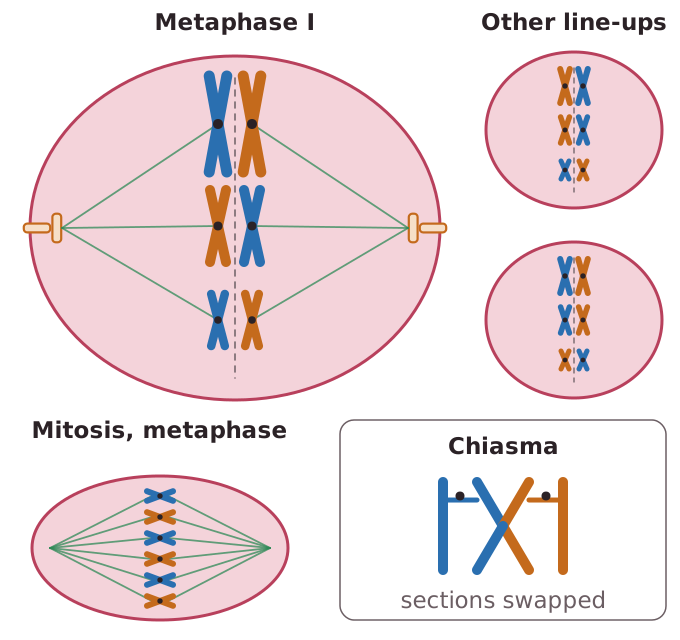 The number of possible combinations of chromosomes in the gametes is:
number of combinations = 2n where n is the number of homologous pairs (the haploid number).Worked example: a species has 2n = 6, so it has 3 homologous pairs. The number of chromosome combinations in its gametes is 23 = 8. In humans n = 23, giving 223 = 8 388 608 combinations.Independent assortment, together with crossing over in prophase I, explains why the gametes produced by one individual are genetically different. The homologous chromosomes move apart in the next stage, anaphase I.
The number of possible combinations of chromosomes in the gametes is: