The rough endoplasmic reticulum (RER) is a system of flattened, membrane-bound sacs called cisternae, whose outer surface is covered with ribosomes. This gives it its 'rough' appearance in electron micrographs. The RER membranes are continuous with the outer membrane of the nuclear envelope, and the fluid-filled space inside the sacs is the lumen.Function
The RER makes and transports proteins, especially those that will be:
• secreted from the cell (such as digestive enzymes, hormones and antibodies)
• inserted into the cell surface membrane or other membranes
• sent to lysosomesHow it works
1. Ribosomes on the RER translate mRNA, and the growing polypeptide is fed through the membrane into the lumen.
2. In the lumen the polypeptide folds into its three-dimensional (tertiary) shape. Some proteins have short carbohydrate chains added.
3. The folded proteins are transported through the cisternae, then pinched off in vesicles.
4. The vesicles move, along the cytoskeleton, to the Golgi apparatus, where the proteins are modified further.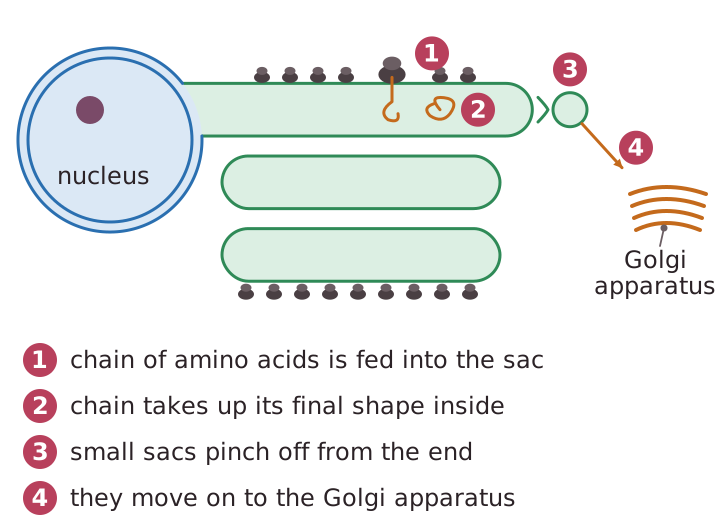 The large surface area of the cisternae gives room for many ribosomes, and the lumen keeps the new proteins separate from the rest of the cytoplasm.Where it is abundant
Cells that secrete large amounts of protein have extensive RER. Examples are the enzyme-secreting cells of the pancreas and plasma cells, which make antibodies.
The RER makes and transports proteins, especially those that will be:
• secreted from the cell (such as digestive enzymes, hormones and antibodies)
• inserted into the cell surface membrane or other membranes
• sent to lysosomesHow it works
1. Ribosomes on the RER translate mRNA, and the growing polypeptide is fed through the membrane into the lumen.
2. In the lumen the polypeptide folds into its three-dimensional (tertiary) shape. Some proteins have short carbohydrate chains added.
3. The folded proteins are transported through the cisternae, then pinched off in vesicles.
4. The vesicles move, along the cytoskeleton, to the Golgi apparatus, where the proteins are modified further.
The large surface area of the cisternae gives room for many ribosomes, and the lumen keeps the new proteins separate from the rest of the cytoplasm.Where it is abundantCells that secrete large amounts of protein have extensive RER. Examples are the enzyme-secreting cells of the pancreas and plasma cells, which make antibodies.