 BRAINCAKE
Golgi Apparatus
The Golgi apparatus (Golgi body) is a stack of flattened, curved, membrane-bound sacs called cisternae, with many small vesicles around its edges. Unlike the ER, the sacs are not connected to one another.
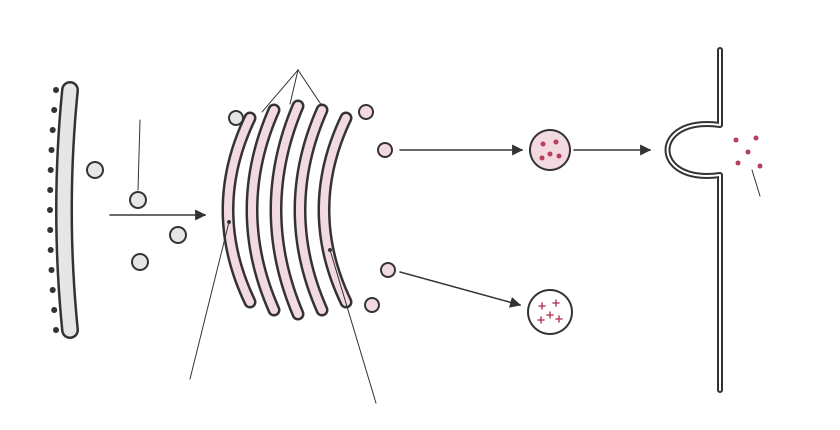
The Golgi apparatus has two faces. Vesicles from the rough ER arrive and fuse with the cis face (the forming face), which is nearer the ER. Vesicles leave from the opposite trans face (the maturing face).
Sign in free to see the rest of this lesson, the R.E.C.I.P.E. recall steps and the quiz
BrainCake is free. Make an account in seconds and pick up where this page stops.
Key terms in this lesson
- cisternae
- Flattened, membrane-bound sacs that make up structures such as the endoplasmic reticulum and Golgi apparatus.
- glycoprotein
- A protein with one or more carbohydrate chains attached, often found on the outer surface of cell membranes as an antigen or receptor.
More in Eukaryotic Cells
All 30 lessons in Eukaryotic Cells · All Edexcel AS-level Biology topics