Proteins from different species can be compared using antibodies. This immunological method shows how similar the proteins are, and so how closely the species are related.The method:
1. Proteins from human blood serum (for example serum albumin) are injected into a rabbit.
2. The rabbit's immune system recognises them as foreign antigens and makes antibodies against them.
3. Serum containing these anti-human antibodies (called antiserum) is collected from the rabbit.
4. The antiserum is mixed with serum from another species. The antibodies bind to any proteins with a similar shape, forming antigen-antibody complexes that clump together as a precipitate.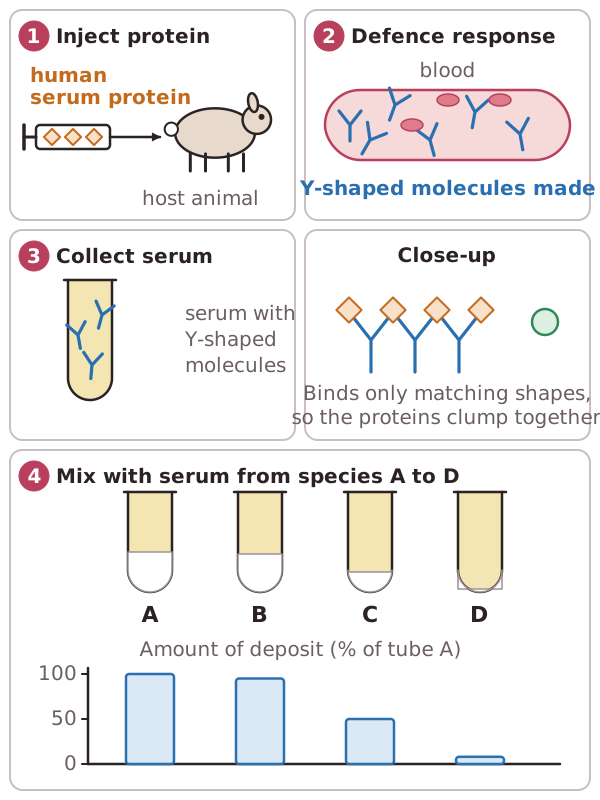 Antibodies bind only to proteins whose shape is complementary to their binding sites. Proteins with similar amino acid sequences have similar shapes. So the more precipitate forms, the more similar the proteins are to the human proteins and the more closely related the species is to humans.Worked example (illustrative data). The amount of precipitate with human serum is taken as 100%.
The chimpanzee gives the most precipitate, so it is most closely related to humans; the pig is least closely related.The method is quick, but it only compares the shape of a few proteins and gives an estimate of similarity, not the exact sequence differences.
1. Proteins from human blood serum (for example serum albumin) are injected into a rabbit.
2. The rabbit's immune system recognises them as foreign antigens and makes antibodies against them.
3. Serum containing these anti-human antibodies (called antiserum) is collected from the rabbit.
4. The antiserum is mixed with serum from another species. The antibodies bind to any proteins with a similar shape, forming antigen-antibody complexes that clump together as a precipitate.
Antibodies bind only to proteins whose shape is complementary to their binding sites. Proteins with similar amino acid sequences have similar shapes. So the more precipitate forms, the more similar the proteins are to the human proteins and the more closely related the species is to humans.Worked example (illustrative data). The amount of precipitate with human serum is taken as 100%.| Species | Precipitate (%) |
|---|---|
| Human | 100 |
| Chimpanzee | 95 |
| Baboon | 50 |
| Pig | 8 |
The chimpanzee gives the most precipitate, so it is most closely related to humans; the pig is least closely related.The method is quick, but it only compares the shape of a few proteins and gives an estimate of similarity, not the exact sequence differences.