Capillaries are the smallest blood vessels. They link arterioles to venules and are the only vessels where substances are exchanged between the blood and the tissues. Their structure is adapted for this exchange:Very thin wall. The wall is made only of endothelium, one cell thick. There is no muscle or elastic tissue, so the diffusion distance between the blood and the surrounding cells is very short.Narrow lumen. The lumen is only about 7 to 10 µm across, roughly the width of a red blood cell. Red blood cells squeeze through in single file, pressed against the wall. This slows them down and reduces the diffusion distance for oxygen even further.Large surface area. Capillaries form extensive networks called capillary beds. No cell in an active tissue is far from a capillary, and the huge number of capillaries gives a very large surface area for exchange.Slow flow. Although each capillary is tiny, their total cross-sectional area is very large, so blood flows through them slowly. This gives more time for exchange.Gaps between endothelial cells. Small gaps (pores) between the cells of the wall allow water and small dissolved substances, such as glucose, amino acids, ions and oxygen, to leave the blood. Red blood cells and large plasma proteins are too big to pass through, so they stay in the capillary.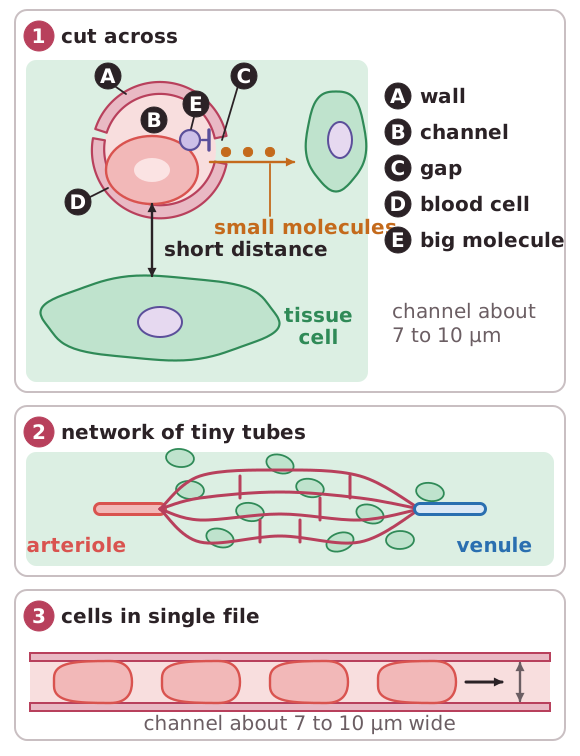 Tissues with a high metabolic rate, such as muscle and the liver, have a particularly dense network of capillaries.