Tissue fluid is a watery liquid that contains glucose, amino acids, fatty acids, ions in a solution and oxygen. It bathes the cells of the body and supplies all these substances to tissues in exchange for waste materials.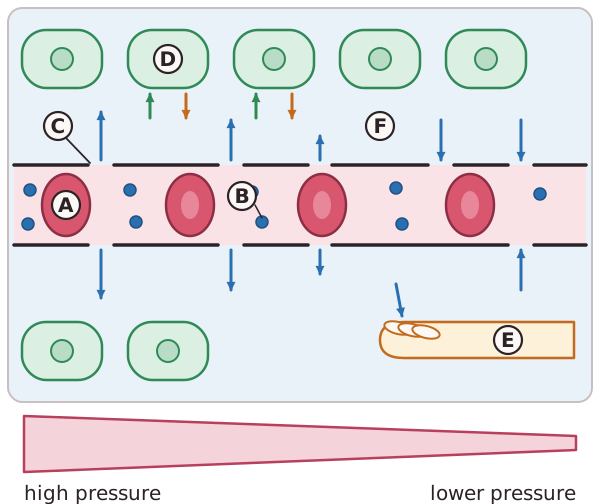 Blood pumping from arteries to arterioles to capillaries creates a hydrostatic pressure at the arterial end of the capillaries. This causes tissue fluid to move out of the blood plasma through gaps in the endothelium. Small molecules are forced out of the capillaries.All cells and proteins in the blood remain in the capillaries as they are too large to cross the membrane. This filtration is called ultrafiltration.The lower water potential of the blood causes some water to move back into the blood within the capillaries.