 BRAINCAKE
Absorption of Amino Acids
Absorption of digested food occurs in the ileum of the small intestine. At the beginning of the small intestine, ions are pumped into the lumen from the epithelial cells. The water potential is lower in the lumen of the small intestine than the epithelial cells and water moves from the epithelial cells lining the small intestine to the lumen by osmosis.
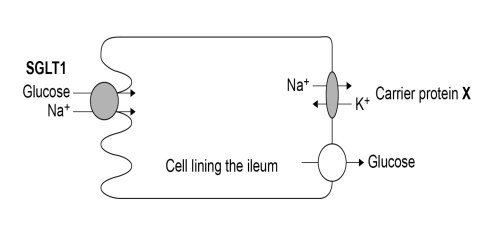
Further along the small intestine ions are pumped back by active transport. The water potential is now lower in the epithelial cells. Water moves from the lumen to the epithelial cells by osmosis. Glucose is absorbed by active transport.
Sodium ions are actively transported from the epithelial cells into the blood by the sodium-potassium pump.
Sign in free to see the rest of this lesson, the R.E.C.I.P.E. recall steps and the quiz
BrainCake is free. Make an account in seconds and pick up where this page stops.
Key terms in this lesson
- monosaccharide
- The monomer from which larger carbohydrates are made, a simple sugar such as glucose.
- diffusion
- The net passive movement of molecules or ions from a region of higher concentration to a region of lower concentration, down a concentration gradient.
- facilitated diffusion
- The passive movement of molecules or ions down their concentration gradient through protein channels or carrier proteins.
- osmosis
- The net movement of water molecules from a region of higher water potential to a region of lower water potential through a selectively permeable membrane.
- water potential
- The pressure created by water molecules, a measure of the tendency of water to move out of a solution; pure water has a water potential of zero and solutes make it more negative.
More in Digestion
- The Digestive System
- Carbohydrate Digestion
- Lipid Digestion
- Protein Digestion
- Structure of the Ileum
- Absorption of Monosaccharides
- Absorption of Triglycerides
- Absorption of Fatty Acids
All 10 lessons in Digestion · All AQA AS-level Biology topics