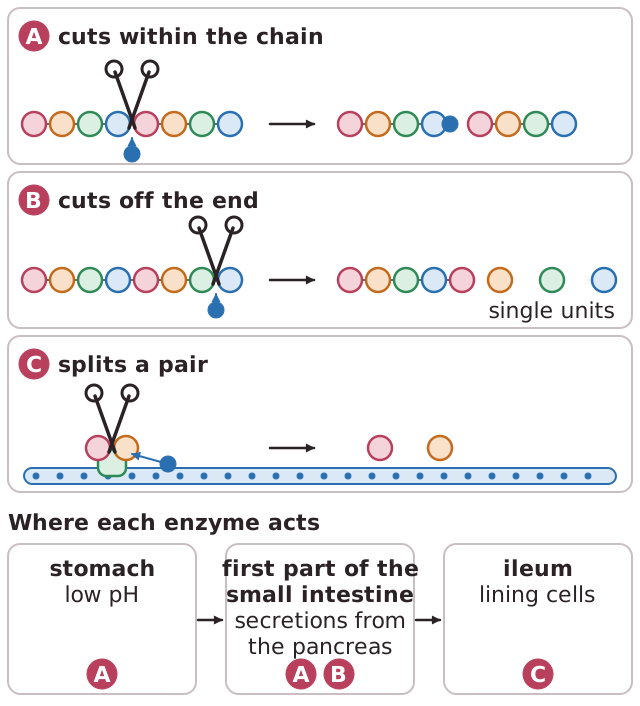
Hydrolysis is the breaking of a covalent bond by the addition of a water molecule. Protein digestion takes place in the stomach, duodenum and ileum by trypsin and the endopeptidases in pancreatic juice.Proteins are broken down into amino-acids by digestion.This involves the breaking of peptide bonds between amino-acid residues by hydrolytic enzymes called proteases.In the stomach, pepsin works at a low pH and is an endopeptidase which breaks peptide bonds within protein molecules.Endopeptidases hydrolyse the peptide bond in the central region of a polypeptide forming shorter polypeptide chains.Pepsin in the stomach is an endopeptidase.Chymotrypsin and trypsin are endopeptidases secreted by the pancreas into the small intestine to break peptide bonds within polypeptides.Exopeptidases hydrolyse peptide bonds at the end of peptide chains progressively releasing amino-acids and dipeptides.Carboxypeptidase is an exopeptidase found in pancreatic juice.Dipeptidases break down dipeptides into single amino-acids.Dipeptidases hydrolyse bonds between two amino acids in a dipeptide.Dipeptidases are membrane-bound and found in epithelial cells lining the ileum.