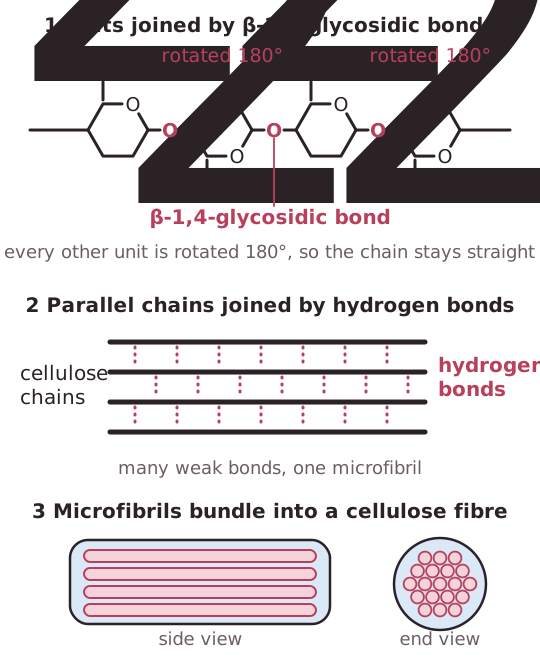
Cellulose is a structural polysaccharide found in plant cell walls. It is made of long chains of β-glucose monomers joined by β-1,4-glycosidic bonds.There are two isomers of glucose, α-glucose and β-glucose, which differ in the position of the -OH group on carbon 1. In β-glucose this -OH group is above the ring, so to form 1,4-glycosidic bonds every other β-glucose molecule must be rotated by 180°.This gives straight, unbranched chains. The chains lie parallel to each other and many hydrogen bonds form between the -OH groups of neighbouring chains, making bundles called microfibrils. Microfibrils group together to form cellulose fibres.Although each hydrogen bond is weak, there are so many that cellulose fibres are very strong. Cellulose cell walls give plant cells strength and rigidity and stop them bursting when water enters by osmosis, so the cells become turgid and help support the plant.