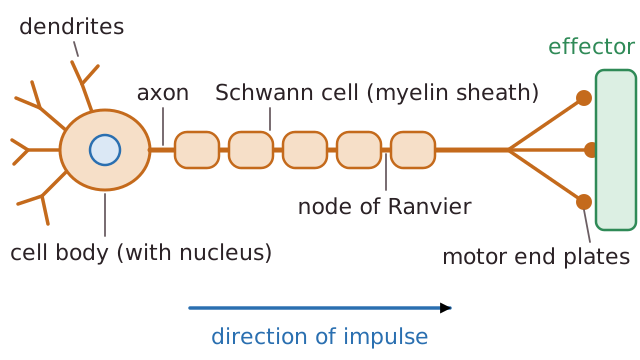
Motor neurones carry electrical impulses from the central nervous system (CNS) to effectors. Effectors are muscles or glands that bring about a response, such as a muscle contracting or a gland secreting a hormone.The cell body of a motor neurone lies inside the CNS, in the brain or spinal cord. It has many short dendrites that receive impulses from relay neurones or sensory neurones.A single long axon carries impulses away from the cell body to the effector. In humans some motor axons are over a metre long, running from the spinal cord to the foot. At its end the axon divides into branches that form motor end plates or synapses with the effector cells.Most impulses therefore follow the pathway: receptor, sensory neurone, relay neurone, motor neurone, effector.