 BRAINCAKE
Sensory Neurones
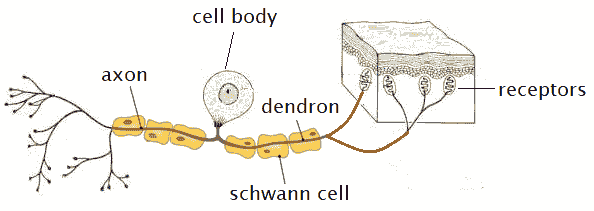
Sensory neurones carry electrical impulses from sensory receptors to the central nervous system (CNS), which is the brain and spinal cord.
A sensory neurone has a long dendron that carries impulses from the receptor towards the cell body, and a shorter axon that carries impulses away from the cell body into the CNS. Dendrites at the end of the dendron connect with the receptor.
Sign in free to see the rest of this lesson, the R.E.C.I.P.E. recall steps and the quiz
BrainCake is free. Make an account in seconds and pick up where this page stops.
Key terms in this lesson
- Neurone
- A specialised nerve cell adapted to transmit electrical impulses (nerve impulses) around the body.
- Sensory receptor
- A specialised cell that detects a stimulus and converts (transduces) it into a generator potential.
More in Neuronal Communication
- Homeostasis
- Cell Signalling
- The Nervous System
- Neurones
- Motor Neurones
- Myelinated Neurones
- Sensory Receptors
- Pacinian Corpuscles
All 38 lessons in Neuronal Communication · All OCR A-level Biology topics