Secondary succession happens on land where soil is already present but the existing community has been removed or destroyed. Examples include land after a forest fire, a cleared woodland, an area after a flood, and an abandoned field.Because soil is already there, it differs from primary succession:
• There is no need for pioneer lichens to weather rock and build soil.
• The soil already contains humus, mineral ions and a seed bank of seeds, roots, rhizomes and spores, as well as soil organisms such as earthworms and decomposers.
• The first colonisers are fast-growing species such as annual weeds and grasses, which germinate quickly from the seed bank or arrive as wind-dispersed seeds.
• These are followed by perennial plants, shrubs and then trees, until a climax community is re-established.So secondary succession is much faster than primary succession. An abandoned field in the UK can become scrub within a few decades and woodland within about a century, whereas primary succession from bare rock can take thousands of years.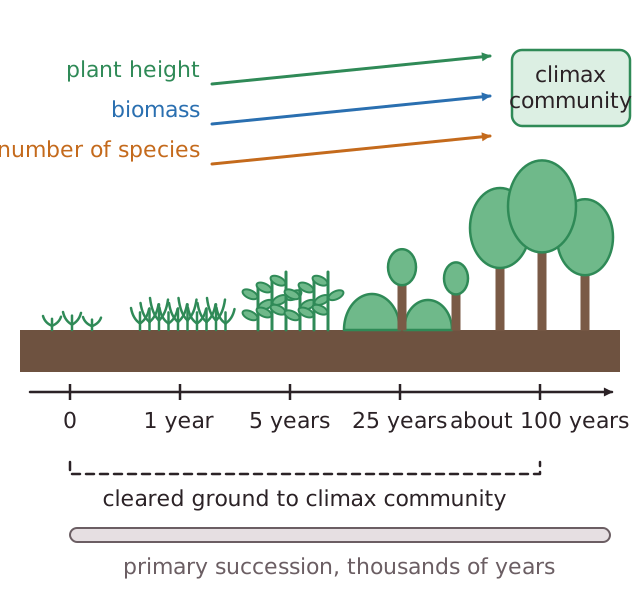 As in primary succession, each community modifies the environment (for example, shrubs and trees shade out grasses), and biodiversity and biomass increase.Worked example. A farmer stops ploughing a field. In the first year it is covered in annual weeds such as poppies. After 5 years, perennial grasses dominate. After 25 years, hawthorn and bramble scrub has spread. This is secondary succession because soil was already present at the start.
• There is no need for pioneer lichens to weather rock and build soil.
• The soil already contains humus, mineral ions and a seed bank of seeds, roots, rhizomes and spores, as well as soil organisms such as earthworms and decomposers.
• The first colonisers are fast-growing species such as annual weeds and grasses, which germinate quickly from the seed bank or arrive as wind-dispersed seeds.
• These are followed by perennial plants, shrubs and then trees, until a climax community is re-established.So secondary succession is much faster than primary succession. An abandoned field in the UK can become scrub within a few decades and woodland within about a century, whereas primary succession from bare rock can take thousands of years.
As in primary succession, each community modifies the environment (for example, shrubs and trees shade out grasses), and biodiversity and biomass increase.Worked example. A farmer stops ploughing a field. In the first year it is covered in annual weeds such as poppies. After 5 years, perennial grasses dominate. After 25 years, hawthorn and bramble scrub has spread. This is secondary succession because soil was already present at the start.