 BRAINCAKE
Primary and Secondary Immune Response
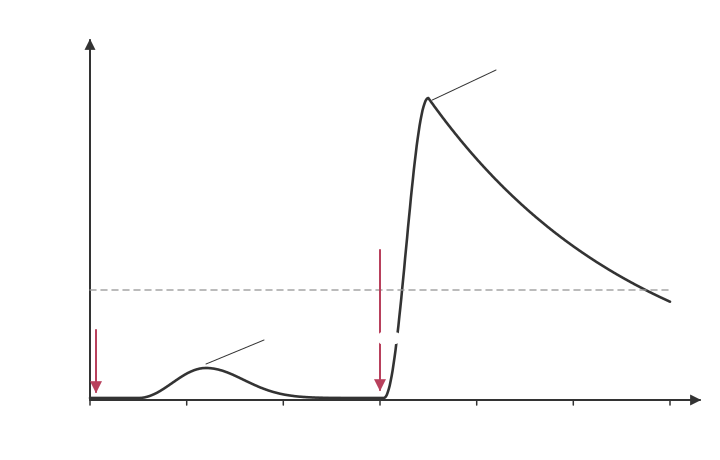
The primary immune response happens the first time the body meets a particular antigen. It is slow: there is a delay of several days while clonal selection takes place, because only a few lymphocytes have complementary receptors and they must be activated and divide to form plasma cells. Antibody concentration in the blood rises slowly, peaking after about 10 to 14 days. During this delay the pathogen multiplies, so the person usually develops symptoms. The primary response leaves behind memory cells (B memory and T memory cells).
The secondary immune response happens if the same antigen enters the body again, even years later. Because there are now many memory cells with complementary receptors, the response is:
Sign in free to see the rest of this lesson, the R.E.C.I.P.E. recall steps and the quiz
BrainCake is free. Make an account in seconds and pick up where this page stops.
Key terms in this lesson
- clonal selection
- The process in which an antigen activates only the lymphocytes with complementary receptors, which then divide to form clones of identical cells.
More in Response to Infection
- Clonal Selection
- Antibodies
- The Cell-Mediated Response
- Cytotoxic T Cells
- Types of Immunity
- Artificial Passive Immunity
- Artificial Active Immunity - Vaccines
- Herd Immunity
All 20 lessons in Response to Infection · All Edexcel A-level Biology topics