Some characteristics are controlled by a single gene (monogenic). These usually show discontinuous variation: individuals fall into a few distinct categories with no intermediates, for example blood group or pea seed shape.Many characteristics are polygenic: they are controlled by several genes at different loci, often on different chromosomes. Examples include human height, skin colour and milk yield in cattle. Each gene has a small, additive effect on the phenotype.Polygenic traits show continuous variation. Because many combinations of alleles are possible, there is a range of phenotypes with no clear categories. When the frequencies are plotted, the data usually form a normal distribution (a bell-shaped curve), with most individuals near the mean.Worked example: suppose height were controlled by three genes (A, B, C), each with a 'tall' allele that adds 5 cm. An individual could have 0 to 6 tall alleles, giving 7 height classes. Most offspring of two AaBbCc parents have 3 tall alleles, and very few have 0 or 6, so a bell-shaped distribution appears.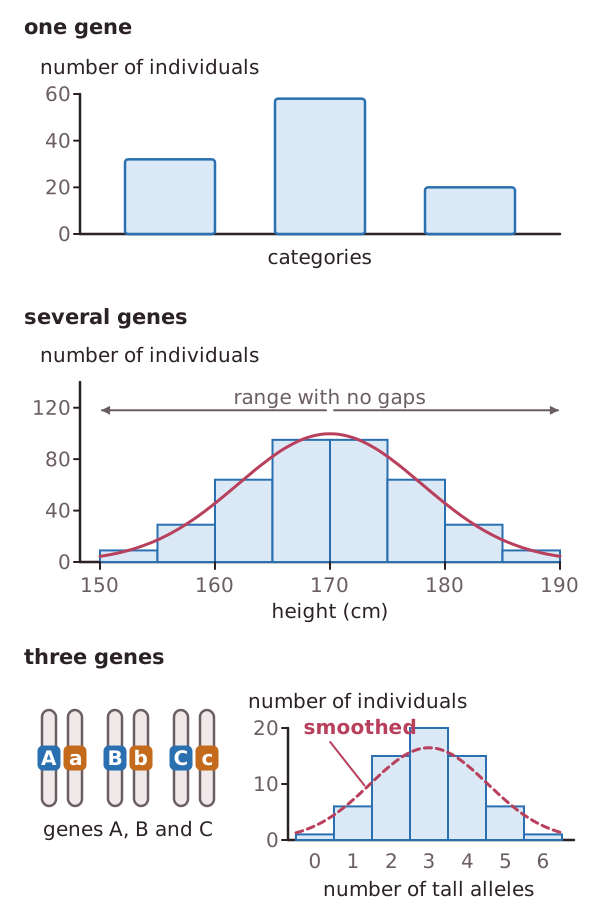 Polygenic traits are also strongly affected by the environment. Diet affects human height and soil minerals affect plant growth. The environment blurs the gaps between genotype classes, making the variation even more continuous.Continuous data are measured (for example in cm or kg) and shown on a histogram. Discontinuous data are counted into categories and shown on a bar chart.