A monohybrid cross follows the inheritance of one characteristic controlled by a single gene with two alleles.A genetic diagram is set out in steps: parental phenotypes, parental genotypes, gametes, offspring genotypes (usually in a Punnett square), offspring phenotypes and the ratio.Worked example: in pea plants, the allele for tall (T) is dominant to the allele for short (t). A homozygous tall plant is crossed with a short plant.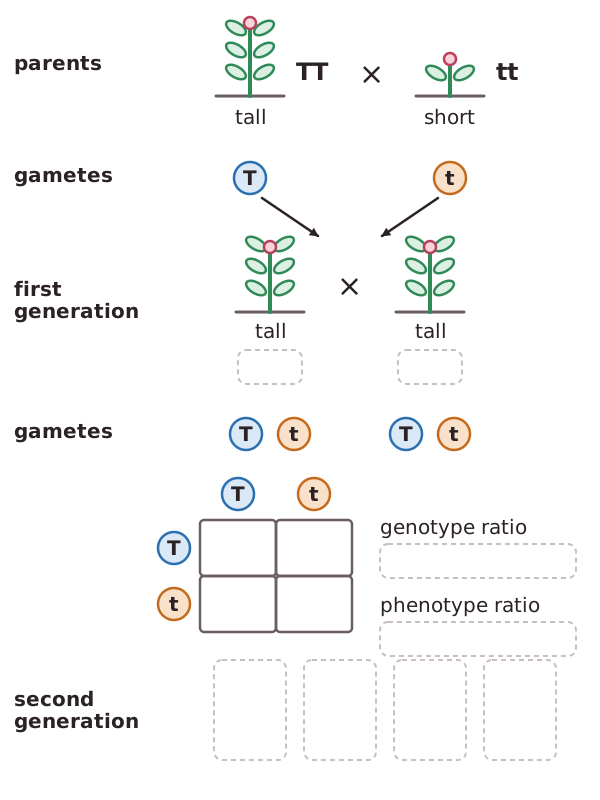 Parents (P): TT × tt
Gametes: all T and all t
First generation (F1): all Tt, all tallTwo F1 plants are then crossed: Tt × Tt. Each parent makes T and t gametes in equal numbers.
F2 phenotypes: 3 tall : 1 shortSo a cross between two heterozygotes gives a 3 : 1 phenotype ratio, and each offspring has a 1 in 4 (0.25) chance of being short. A cross between a heterozygote and a homozygous recessive (Tt × tt) gives a 1 : 1 ratio.These ratios are expected (predicted) ratios. They are probabilities for each offspring, so the real numbers counted in an experiment will rarely match them exactly.
Parents (P): TT × ttGametes: all T and all t
First generation (F1): all Tt, all tallTwo F1 plants are then crossed: Tt × Tt. Each parent makes T and t gametes in equal numbers.
| T | t | |
| T | TT | Tt |
| t | Tt | tt |
F2 phenotypes: 3 tall : 1 shortSo a cross between two heterozygotes gives a 3 : 1 phenotype ratio, and each offspring has a 1 in 4 (0.25) chance of being short. A cross between a heterozygote and a homozygous recessive (Tt × tt) gives a 1 : 1 ratio.These ratios are expected (predicted) ratios. They are probabilities for each offspring, so the real numbers counted in an experiment will rarely match them exactly.