 BRAINCAKE
Early Stages of Development
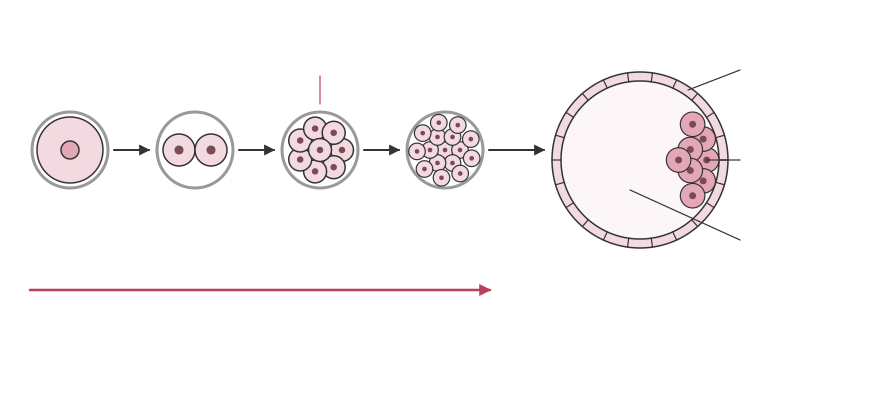
A new organism begins as a single cell, the zygote, formed when an egg is fertilised by a sperm. In humans, the early stages of development follow a set pattern.
Cleavage
The zygote divides repeatedly by mitosis as it moves along the oviduct towards the uterus. These divisions are called cleavage. The embryo does not grow in size, so each new cell is smaller than the one it came from. After about 3 to 4 days the embryo is a solid ball of around 16 cells called a morula. The cells of the very early embryo, up to about the 8-cell stage, are totipotent.
The blastocyst
By about day 5, a fluid-filled cavity forms and the embryo becomes a blastocyst, a hollow ball of about 100 or more cells. It has two distinct groups of cells:
Sign in free to see the rest of this lesson, the R.E.C.I.P.E. recall steps and the quiz
BrainCake is free. Make an account in seconds and pick up where this page stops.
Key terms in this lesson
- totipotent
- Describes a cell able to divide and differentiate into any cell type of an organism, including extra-embryonic tissues such as the placenta.
- pluripotent
- Describes a cell able to differentiate into any type of body cell, but not extra-embryonic tissues such as the placenta.
More in Gene Expression
- Histone Methylation
- non-Coding RNA
- siRNA
- Cell Differentiation
- Stem Cells
- Embryonic Stem Cells
- Umbilical Cord Stem Cells
- Adult Stem Cells
All 39 lessons in Gene Expression · All Edexcel A-level Biology topics