Animals that move around, such as woodlice, beetles, snails, fish and small mammals, cannot be sampled with quadrats. Their population size is estimated by mark-release-recapture.Method
1. Capture a sample of the animals using a suitable method, such as pitfall traps for ground beetles or netting for fish.
2. Count them and mark each one in a way that is harmless and will not wash off, for example a small dot of non-toxic paint on a beetle's underside.
3. Release them back where they were caught.
4. Leave enough time for the marked animals to mix randomly with the rest of the population.
5. Capture a second sample, using the same method and effort, and count how many are caught in total and how many of these are marked.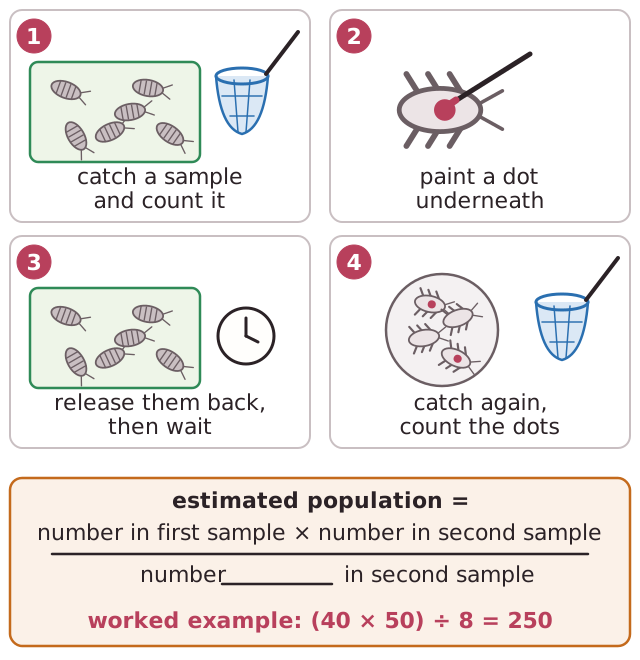 The idea is that the proportion of marked animals in the second sample equals the proportion of marked animals in the whole population. This gives:
estimated population size = (number caught in first sample × number caught in second sample) ÷ number marked in second sample Worked example
40 woodlice are caught, marked and released. A week later, 50 woodlice are caught, of which 8 are marked.population = (40 × 50) ÷ 8 = 250 woodlice The estimate is only as good as the assumptions it relies on, and a large sample size makes it more reliable.
1. Capture a sample of the animals using a suitable method, such as pitfall traps for ground beetles or netting for fish.
2. Count them and mark each one in a way that is harmless and will not wash off, for example a small dot of non-toxic paint on a beetle's underside.
3. Release them back where they were caught.
4. Leave enough time for the marked animals to mix randomly with the rest of the population.
5. Capture a second sample, using the same method and effort, and count how many are caught in total and how many of these are marked.
The idea is that the proportion of marked animals in the second sample equals the proportion of marked animals in the whole population. This gives:40 woodlice are caught, marked and released. A week later, 50 woodlice are caught, of which 8 are marked.