The body can respond to dangerous situations without conscious thought. A reflex action is a rapid, involuntary response that minimises damage to the body.The nervous pathway involved is called a reflex arc. The stimulus is detected by a receptor, which creates an action potential in the sensory neurone. The impulse travels from the sensory neurone to a relay neurone in the spinal cord, then to a motor neurone which carries the impulse to the effector to carry out the response.
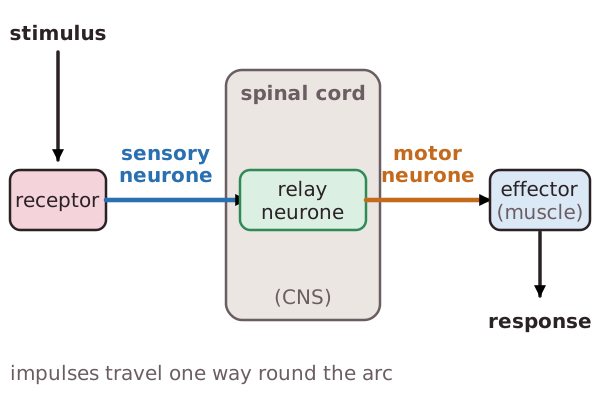
Reflex Arc
Read the text
Read the text and highlight anything you think is important. When you go on, the text is hidden and you answer from memory.
Specification: AQA Biology (7402), A-level, 3.6.1.1 Survival and response. Topic: Neuronal Communication.
More in Neuronal Communication
- Sino-Atrial Node
- Contraction of the Heart
- Autonomic Control of the Heart Rate
- Chemoreceptors
- Pressure Receptors
- Taxes
- Kinesis
- Tropisms
All 38 lessons in Neuronal Communication · All AQA A-level Biology topics