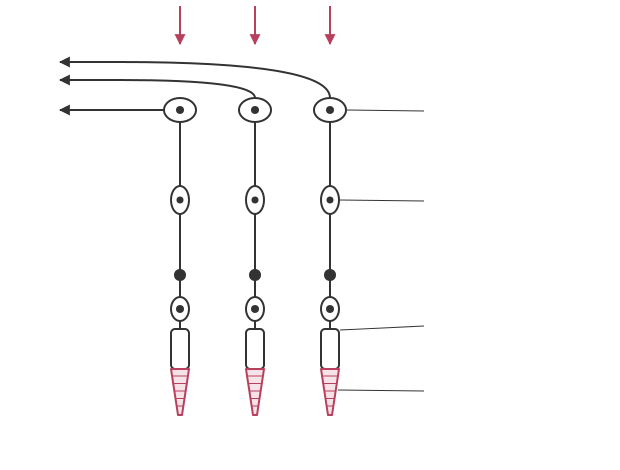
There are about 6 million cone cells in the human eye concentrated in the fovea (the part of the retina opposite the pupil) with the numbers decreasing to none towards the peripheral parts of the eye.Each cone cell is connected to a separate bipolar neurone so cone cells only respond to high light intensity and the brain receives a separate impulse from each cone cell. This means that the brain can distinguish between the two sources of light that stimulate two adjacent cone cells and cone cells have high visual acuity.There are three different types of cone cell - able to distinguish between red, green and blue light.