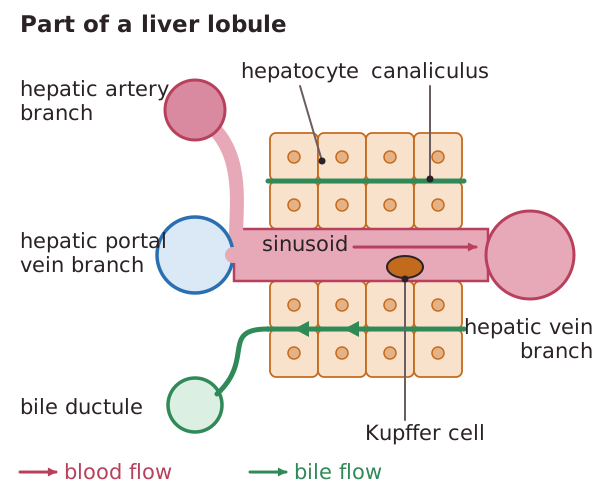
The liver is divided into lobes, which divide further into cylindrical lobules. Liver cells are called hepatocytes, have large nuclei and lots of Golgi and mitochondria. Blood from branches of the HPV and hepatic artery are mixed in spaces called sinusoids supplying cells with enough oxygen for their metabolic activity. Kupffer cells in the sinusoids are macrophages that engulf microorganisms and foreign particles and old red blood cells. The blood drains into a branch of the hepatic vein. Hepatocytes secrete bile into canaliculi. This drains into a branch of the bile duct (ductules) which leads to the gall bladder.
Structure of the Liver
Read the text
Read the text and highlight anything you think is important. When you go on, the text is hidden and you answer from memory.
Specification: AQA Biology (7402), A-level, 3.6.4.2 Control of blood glucose concentration and 3.6.4.3 Control of blood water potential. Topic: Homeostasis.
Key terms in this lesson
- insulin
- A hormone secreted by the beta cells of the islets of Langerhans in response to a rise in blood glucose concentration, which lowers blood glucose by stimulating cells to take up and use or store glucose.
More in Homeostasis
- Cooling
- Warming Up
- Excretion
- The Liver
- Carbohydrate Metabolism in the Liver
- Transamination and Deamination
- Detoxification
- Production of Bile Salts, Bile Pigments and Cholesterol
All 33 lessons in Homeostasis · All AQA A-level Biology topics