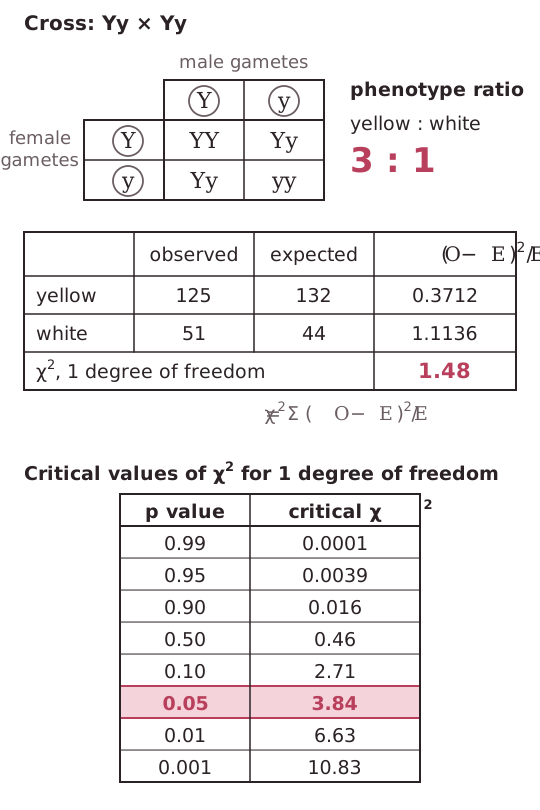
The Chi-squared test is a statistical test that measures the difference between the observed and expected values and tests whether or not the differences are statistically significant or just due to chance.For each category, the expected values are subtracted from the observed values (O - E) and then the result is squared to give (O - E)2. The values for each category are divided by the expected value to give (O - E)2/E and then added up to give Χ2 = Σ(O - E)2/E.Large Χ2 values mean the difference is statistically significant and not just due to chance. The degree of freedom is one less than the number of categories. For a chosen significance level a Χ2 value more than the critical value indicates the difference is not due to chance.