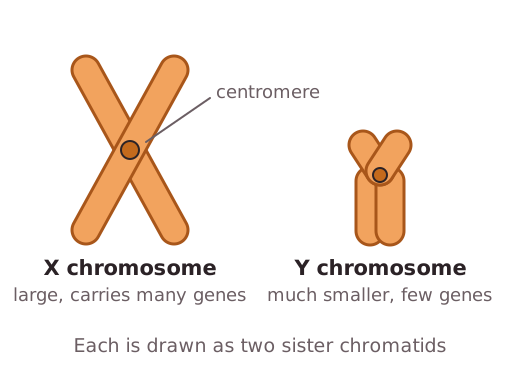
In humans, there are 23 pairs of homologous chromosomes. 22 pairs are called autosomes and there is a pair of sex chromosomes. Females have two X chromosomes and males have an X and a Y chromosome. The Y chromosome has few genes. All mammals would develop as females in the absence of the genes on the Y chromosome which stimulate primary sexual development in the embryo.As females are XX and have two X chromosomes (the homogametic sex) if there is a faulty gene on one of the X chromosomes this will be masked by a functioning gene on the other as long as the allele is recessive. As males only have one X chromosome and are XY (the heterogametic sex) any faulty genes on the X chromosome will not be masked.