A leaf can be cut and then exposed to Agrobacterium tumefaciens which has been genetically engineered to include a recombinant plasmid. The bacteria infects the leaf cells and the leaf can be exposed to antibiotics that will kill cells which do not have the new genes.The transgenic cells will form a clump called a callus which will eventually grow roots and shoots if placed on a nutrient medium. The plantlets can then be transferred to pots and then to the soil where they grow into adult plants.
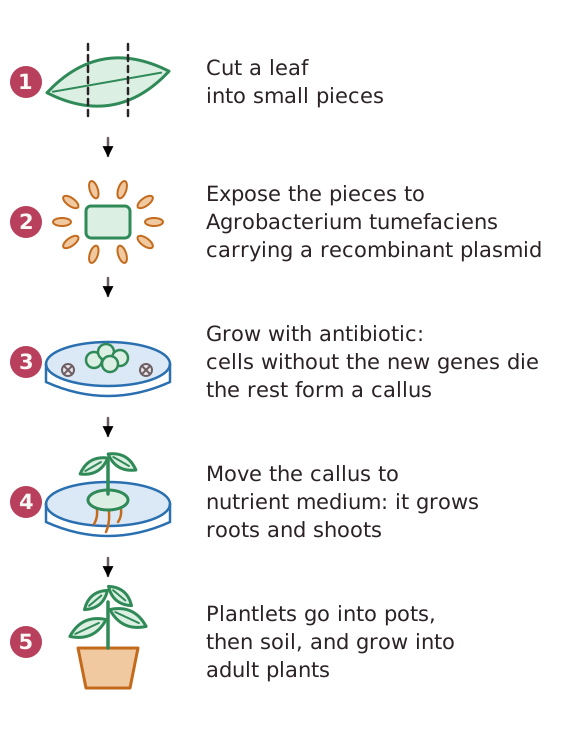
Genetically Engineering Plants
Read the text
Read the text and highlight anything you think is important. When you go on, the text is hidden and you answer from memory.
Specification: AQA Biology (7402), A-level, 3.8.4.1 Recombinant DNA technology. Topic: Genetic Engineering and Biotechnology.
Key terms in this lesson
- mutation
- A random change in the base sequence of DNA (a gene mutation) or in the structure or number of chromosomes (a chromosome mutation).
- genotype
- The genetic constitution of an organism, i.e. the particular combination of alleles it possesses.
- epigenetics
- The control of gene expression by heritable changes, such as histone modification and DNA methylation, that alter chromatin structure without changing the base sequence of DNA.
More in Genetic Engineering and Biotechnology
- Genomics and Proteomics
- Recombinant DNA
- Genetic Engineering
- Genetically Engineering Different Organisms
- Ethical Concerns - microorganisms
- GM plants
- Patenting
- GM animals
All 23 lessons in Genetic Engineering and Biotechnology · All AQA A-level Biology topics