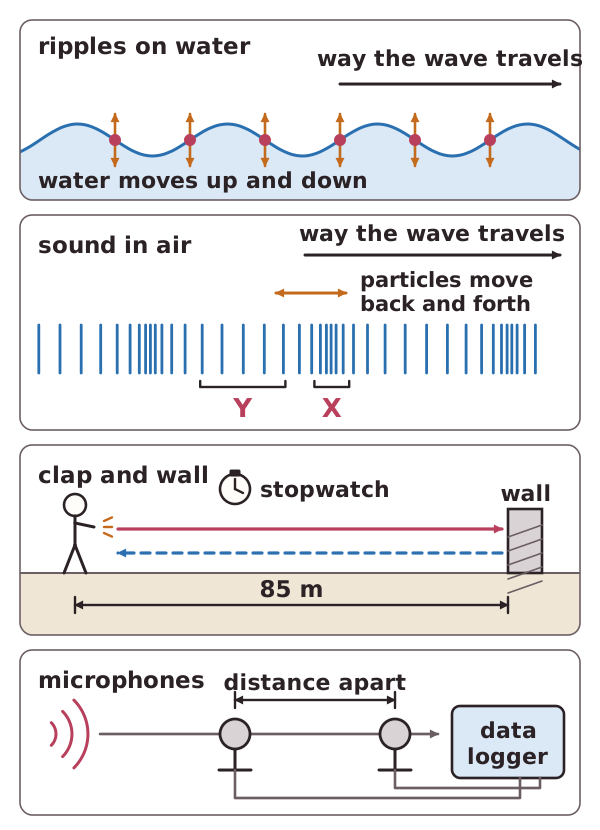
Ripples on the surface of water are used to model transverse waves. The water moves up and down at right angles to the direction the wave travels. Sound waves in air are longitudinal. The air particles vibrate backwards and forwards parallel to the direction of travel, which makes regions where they are squashed together, called compressions, and regions where they are spread out, called rarefactions.
For any wave, wave speed (m/s) = frequency (Hz) × wavelength (m). In a ripple tank, the frequency is set by the vibrating dipper. The wavelength is measured from a photograph, or by using a stroboscope to make the waves appear to stand still, then measuring several wavelengths and dividing. For example, ripples of frequency 5 Hz and wavelength 0.02 m have a speed of 5 × 0.02 = 0.1 m/s. For a fixed frequency, a longer wavelength means a higher wave speed.
The speed of sound in air, about 330 m/s, can be measured by timing an echo. A student claps in front of a large wall and times how long the echo takes to return. The sound travels to the wall and back, so the total distance is twice the distance to the wall, and speed = distance ÷ time. For instance, a wall 85 m away and an echo after 0.5 s gives 170 ÷ 0.5 = 340 m/s. Another method places two microphones a measured distance apart and uses a data logger to find the time delay between them. The speed is the distance between the microphones divided by the time.