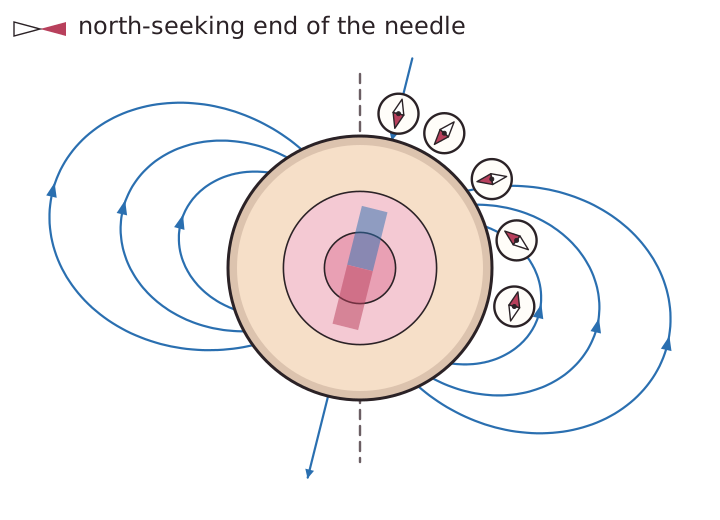
A plotting compass is a small magnet on a pivot, free to turn. The needle lines up with the magnetic field it is in. Its north-seeking end points towards the Earth's geographic North Pole. A north pole is attracted to a south pole, so the Earth has a magnetic south pole near the geographic North Pole, and the compass points that way.
A dipping compass is pivoted so that the needle can tilt up and down as well as turn. Near the equator the needle lies flat. As you travel towards a pole, it tilts more steeply, and at the magnetic pole it points straight down.
This pattern of compass directions is the same as the field around a bar magnet. The magnetic field is strongest at the poles, where the field lines are closest together. So the Earth behaves as if it has a huge bar magnet inside it, and the source of the field must be the core. The core is made mostly of iron and nickel, which are magnetic materials, and the outer core is liquid.
The magnetic poles are not in the same place as the geographic poles, which is why a compass does not point exactly to true north.