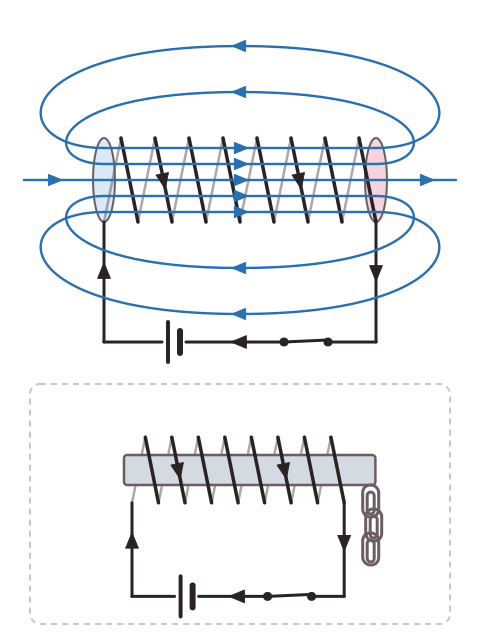
A current in a straight wire makes only a weak magnetic field. If the wire is wound into a coil, the field gets much stronger. A long coil of wire like this is called a solenoid. Each turn of the coil makes its own field, and inside the coil these fields add together.
The field of a solenoid has the same shape as the field of a bar magnet. One end acts as a north pole and the other as a south pole. Inside the solenoid the field is strong and uniform, which means it has the same strength and direction at every point. If the current is reversed, the poles swap over. When the current is switched off, the magnetic field disappears.
You can make the magnetic effect stronger in several ways. Increase the current. Add more turns of wire. Wind the same number of turns into a shorter coil, so the turns are packed closer together. You can also put a core of soft iron inside the solenoid. Iron is a magnetic material, so it becomes magnetised by the field and makes the total field much stronger. The result is called an electromagnet.
To investigate a solenoid, place plotting compasses around it and mark the direction each compass points. To test one factor, such as the number of turns, change only that and keep the current and the length the same. The strength can be compared by counting how many paper clips the electromagnet can pick up.