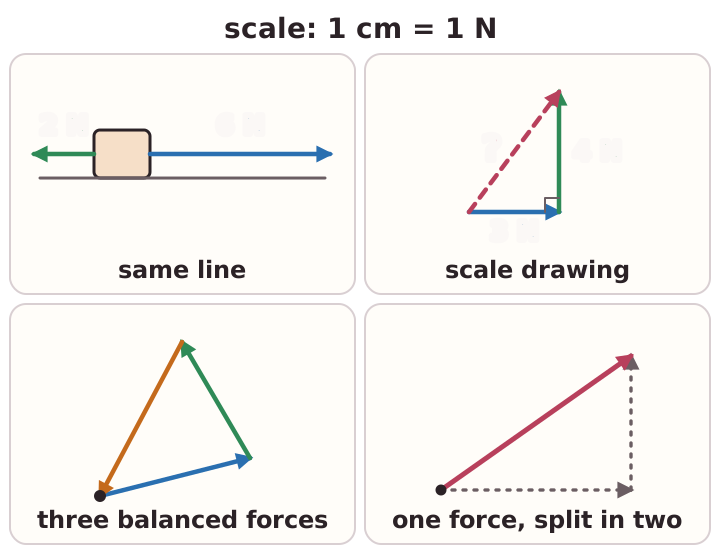
When several forces act on an object we can replace them with one resultant force. If two forces act along the same line in the same direction, add them. If they act in opposite directions, subtract the smaller from the larger, and the resultant acts in the direction of the larger force. For example, 8 N one way and 3 N the other way gives a resultant of 5 N in the direction of the larger force.
For forces at right angles, draw a scale drawing. Draw the first force as an arrow to scale, then draw the second force starting from the head of the first, so the arrows go head to tail. The resultant is the straight line from the start of the first arrow to the end of the second. A 3 N force and a 4 N force at right angles give a resultant of 5 N, and 6 N and 8 N give 10 N. A single force can also be resolved, which means split into two components at right angles that together have the same effect as the original force.
An object is in equilibrium when the forces on it balance and the resultant force is zero. On a vector diagram the force arrows, drawn head to tail, form a closed shape that ends where it started.