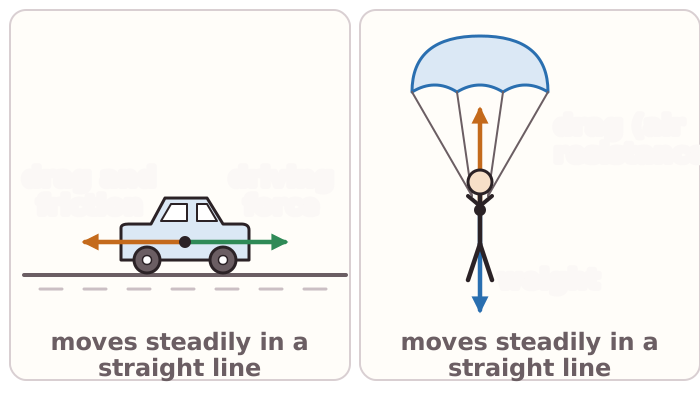
Newton's first law says that an object stays at rest, or keeps moving at a constant (uniform) velocity in a straight line, unless a resultant force acts on it. The resultant force is the single force that has the same effect as all the forces acting on the object. When the resultant force is zero, the forces are balanced and the motion does not change.
This means a force is not needed to keep something moving. A puck sliding across very smooth ice keeps going at a steady speed because there is almost no friction. A car moving at a steady speed on a straight road has a driving force equal to the resistive forces, so the resultant force is zero.
When the resultant force is not zero, the motion changes. The object can change its speed or change direction. A braking car slows down because the resultant force acts against its motion. A satellite in orbit moves at constant speed in a circle, but its direction keeps changing, so its velocity is changing and there must be a resultant force pulling it towards the centre.