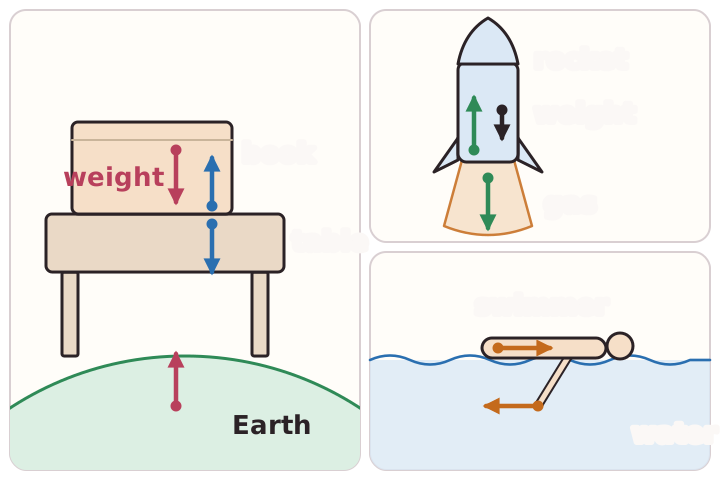
Newton's third law says that when two objects interact, they exert forces on each other that are equal in size and opposite in direction. The two forces are the same type of force, and they act on different objects. This is why they are called an interaction pair.
Because the pair acts on different objects, the two forces never cancel each other out. A book resting on a table is in equilibrium because two forces act on the book: its weight, which is the pull of the Earth on the book, and the normal contact force from the table. They are equal and opposite, so the resultant force on the book is zero. But these two are not a third-law pair, because they act on the same object. The pair of the weight is the gravitational pull of the book on the Earth. The pair of the contact force is the downward push of the book on the table.
In non-equilibrium situations the third law still holds. A rocket engine pushes exhaust gas downwards, and the gas pushes the rocket upwards with an equal force. The rocket accelerates because the resultant force on it is not zero, for example when the thrust is larger than its weight.